
 Google AI
 ChatGPT
 Perplexity
Are you tired of checking every investment to make sure it’s Halal? Does the world of finance feel like a complicated maze where Riba (interest) is hiding around every corner? You’re not alone. Many Muslim investors in the U.S. struggle to find investment opportunities that respect their faith and deliver real growth.
You’ve got the savings, the desire to grow your wealth, and the determination to secure your family’s future, but that nagging worry about riba-based transactions stops you dead in your tracks. Every traditional investment option, such as stocks, bonds, and mutual funds, seems to carry a built-in interest component or involve haram (prohibited) industries like alcohol, gambling, or conventional finance. It’s exhausting to constantly vet portfolios and screen for compliance.
This deep-seated need for ethical, Shariah-compliant growth is precisely why Halalvest Real Estate LLC exists. We understand that your financial goals shouldn’t come at the expense of your faith. We offer a trusted, transparent solution that eliminates the Riba worry and focuses on tangible, ethical real estate assets. Stop compromising, start growing your wealth with confidence.
Why Your Current Investments May Be Risky (Spiritually & Financially)
The core risk for a Muslim investor lies in the prohibition of Riba. Spiritually, engaging in Riba is considered a major sin in Islam, invalidating the purpose of wealth accumulation. Many conventional investment funds or products generate returns based on fixed-interest loans or bonds, which are explicitly forbidden.
Beyond the spiritual mandate, there’s also a financial risk. Often, non-compliant, speculative ventures, especially those that rely heavily on excessive debt or derivative products, can be structurally unsound. By avoiding Riba and highly speculative markets, you naturally gravitate toward more stable, asset-backed investments. The key is finding ethical halal investment funds that screen not just the returns but the source of those returns, ensuring compliance and often resulting in greater long-term stability.
Your Simple Guide to Understanding Halal Investment Structures
This comprehensive 3000-word guide will be your clear, concise breakdown of the main models for Shariah-compliant investments. We will demystify terms and show you how to build a portfolio that aligns with your faith.
What are Halal Investment Structures?
Halal investment structures are financial arrangements compliant with Shariah (Islamic law), primarily by avoiding the prohibition of Riba (interest), excessive uncertainty (Gharar), gambling (Maysir), and investment in prohibited industries (like alcohol, pork, or conventional finance). These structures are typically based on profit-and-loss sharing, equity participation, or leasing models, where returns are generated from tangible assets or legitimate trade, ensuring a just and ethical partnership between investors and entrepreneurs.
Islamic Ethical Investment Principles: The Foundation
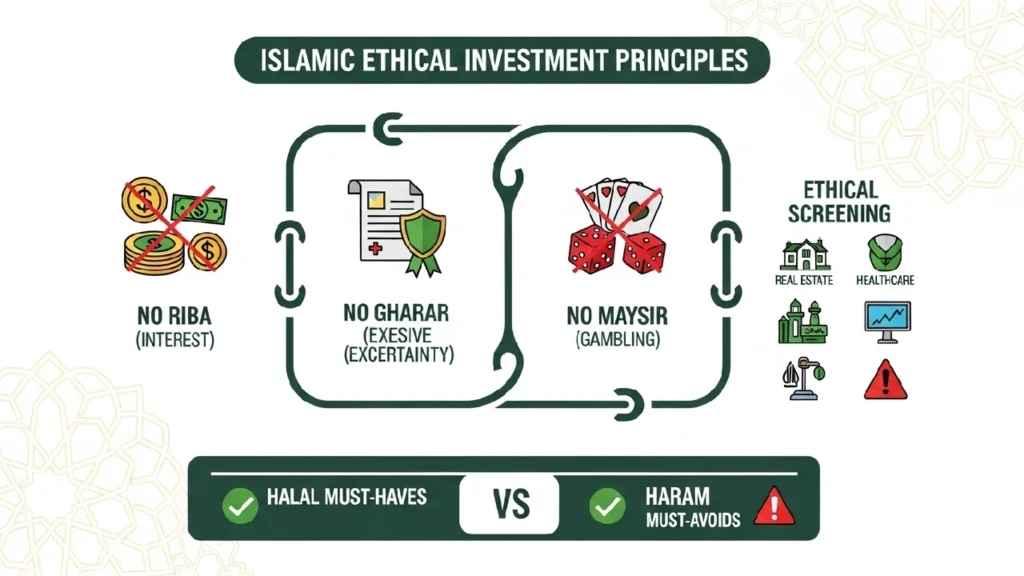
Islamic ethical investment principles go far beyond just avoiding Riba (interest). They establish a comprehensive framework for moral and equitable finance, ensuring that all wealth is generated through legitimate, value-creating means. Understanding these core rules is essential before diving into specific investment structures.
Here are the four foundational principles:
- No Riba (Interest): This is the most famous rule. It prohibits all forms of interest, whether fixed or floating, on loans. In Islamic finance, money is not treated as a commodity that can “earn” more money simply by lending it. Returns must be generated through tangible trade, production, or legitimate partnership where both profit and loss are shared.
- No Gharar (Excessive Uncertainty): This prohibits transactions with excessive or ambiguous risk. It targets contracts where the outcome is highly uncertain or the fundamental subject matter is unknown. This principle discourages harmful speculation and complex derivatives, promoting clarity and transparency.
- No Maysir (Gambling or Speculation): This bans transactions based purely on chance or luck, where one party loses for another to gain without any real economic activity or value creation. It prevents gambling and overly speculative financial products.
- Ethical Screening (No Prohibited Industries): Investments must be screened to ensure the underlying business does not involve industries considered Haram (forbidden) in Islam.
| Halal Must-Haves (Permitted) | Haram Must-Avoids (Forbidden) |
| Asset-Backed Investment (e.g., Real Estate) | Riba (Any Form of Interest/Debt-Based Lending) |
| Profit & Loss Sharing (Equity-Based Partnerships) | Gharar (Excessive Uncertainty/Ambiguity) |
| Tangible, Value-Creating Trade & Production | Maysir (Gambling/Pure Speculation) |
| Ethically Screened Industries (Technology, Healthcare, etc.) | Prohibited Industries (Alcohol, Pork, Conventional Banking, Pornography, etc.) |
Murabaha Explained: The Trustworthy Purchase Model
What is Murabaha? (Cost-Plus Financing)
Murabaha is one of the most common and simple Islamic finance investment models. It is essentially a cost-plus-profit sale, and not a loan based on interest (Riba).
In a Murabaha transaction, the bank or investor acts as a legitimate merchant. The process is straightforward:
- A client identifies an asset (e.g., a car, equipment, or a piece of real estate).
- The bank/investor purchases the asset directly from the original seller.
- The bank/investor then sells the asset to the client for the original cost plus a pre-agreed, fixed, and transparent profit margin.
- The client pays the total amount (cost + profit) in installments over an agreed-upon period.
Because the profit is a legitimate return on a sale where the bank takes ownership risk before selling and is not simply interest on money, it satisfies Shariah requirements. It’s a transparent and ethical guide to Islamic finance investment models used globally.
Real-World Example: Hybrid Murabaha + Mudarabah (Retail Building Purchase)
While classic Murabaha is often used for simple financing, Halalvest Real Estate LLC utilizes a sophisticated Hybrid Murabaha + Mudarabah model to maximize both compliance and investor returns in real estate.
Consider the purchase of a retail building in a prime U.S. location:
- Murabaha Component (Acquisition): Halalvest (the investor/financier) first uses investor capital to purchase the retail building outright from the seller. The ownership and the risk of the asset are genuinely transferred to Halalvest, fulfilling the requirement for a real sale. Halalvest then enters a Murabaha-style agreement to sell the building to an operating partner or special purpose vehicle (SPV) at a known, fixed, higher price payable over a short term. This locks in the initial compliant profit on the acquisition.
- Mudarabah Component (Operations/Profit Sharing): Crucially, the operating partner who holds the building does not pay the entire Murabaha amount upfront. Instead, Halalvest and the operating partner enter a Mudarabah (profit-sharing) agreement regarding the income generated by the retail building (e.g., rental income, future sale profits). Halalvest provides the capital (Rabb-ul-Maal), and the operating partner offers the management and labor (Mudarib). The monthly rental income and the final profit from the eventual sale of the building are split according to a pre-agreed ratio (e.g., 70/30), which is separate from the Murabaha sale price.
This hybrid approach layers a dynamic, profit-sharing element (Mudarabah) onto the asset transfer model (Murabaha). It provides investors with both a stable, agreed-upon profit on the initial sale and exposure to the upside from the building’s operational success, ensuring returns are tied directly to the performance of a real, tangible asset.
Musharakah & Mudarabah: Sharing the Risk, Sharing the Reward
Understanding Musharakah (Partnership)
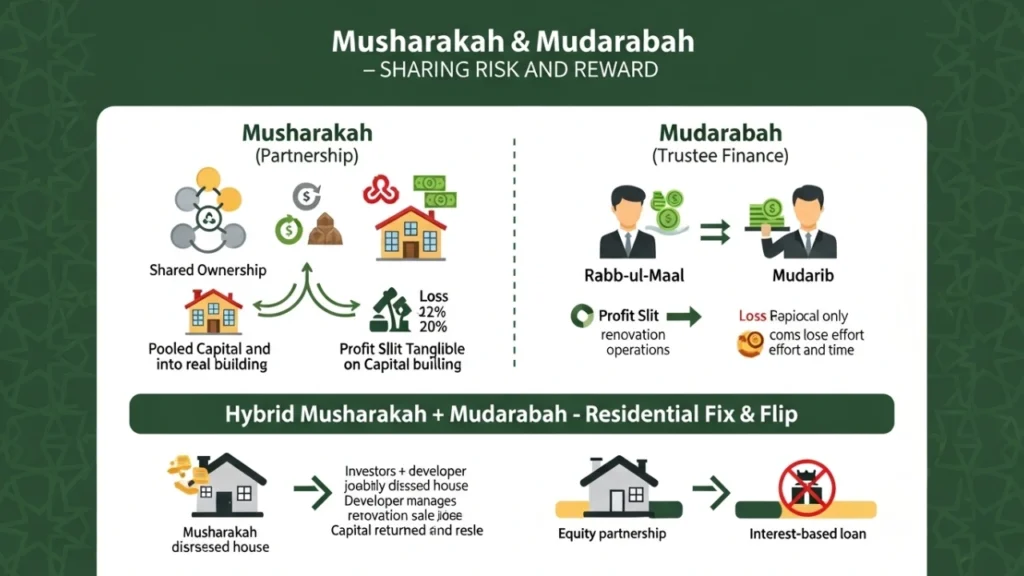
Musharakah is a classic Islamic partnership contract. Its essence is shared ownership and responsibility.
- Definition: Two or more parties (partners) contribute capital, assets, or effort to a venture. The profits generated from the venture are shared among the partners based on a pre-agreed ratio (which doesn’t have to strictly mirror the capital contribution). Critically, any losses must be shared strictly in proportion to the partners’ respective capital contributions.
- Application: Musharakah is fundamental to how to structure halal real estate investments, as it allows multiple investors to pool funds to purchase a tangible asset (like a building or land), genuinely sharing the risks and rewards associated with that asset’s performance.
Understanding Mudarabah (Trustee Finance)
Mudarabah is a specialized form of partnership that differentiates between capital and management.
There are two parties:
- The Rabb-ul-Maal (Capital Provider/Investor, e.g., Halalvest): Provides 100% of the capital.
- The Mudarib (Manager/Expertise Provider, e.g., Partner/Developer): Provides the management, skill, and effort.
Profit & Loss: Profits are shared based on a pre-agreed ratio. However, suppose the venture incurs a loss (not due to negligence by Mudarib). In that case, the entire financial loss is borne solely by the Rabb-ul-Maal (the capital provider). The Mudarib only loses the time and effort invested. This structure ensures fairness and protects the active manager from financial ruin in case of market downturns.
Halalvest’s Powerful Hybrid Approach (Residential Fix & Flip)
Halalvest often employs a Hybrid Musharakah + Mudarabah model for quick-turnaround projects like a residential Fix & Flip. This model leverages the strengths of both partnership types to manage capital, expertise, and risk ethically.
Model Breakdown (Fix & Flip):
- Musharakah Component (Acquisition): Halalvest investors contribute the majority of the capital, and the experienced developer/partner contributes a smaller portion of the capital alongside their labor and management. This pooled capital is used to purchase the distressed residential property. All partners become shared owners, fulfilling the Musharakah requirement.
- Mudarabah Component (Execution): The developer/partner takes on the role of the Mudarib (manager), overseeing the repairs, renovation, and eventual sale of the property. Halalvest and its investors act as the Rabb-ul-Maal (capital provider).
- Profit Split: Once the renovated property is sold, the initial capital is returned. The remaining profit is split based on a ratio agreed upon at the start (e.g., a tiered split that rewards the developer for hitting targets).
Interest-Based Loans for Flipping: A conventional flip relies on a “hard money loan,” which is short-term, high-interest debt. The developer is locked into fixed monthly payments regardless of the project’s success or delays. If the sale is delayed, the interest payments can wipe out the profit. This is pure Riba.
Equity Partnership Model: The Hybrid Musharakah/Mudarabah model is an equity partnership. Halalvest and the developer share the risk. If the project is delayed, the cost of capital doesn’t spiral with fixed interest; instead, the potential profit split is simply delayed. There are no fixed debt payments, eliminating the spiritual worry of Riba and aligning the financial interests of both parties perfectly toward maximizing the final sale price.
Ijara: The Shariah-Compliant Lease
Ijara (Lease) vs. Ijara Muntahia Bi Tamleek (Lease-to-Own)
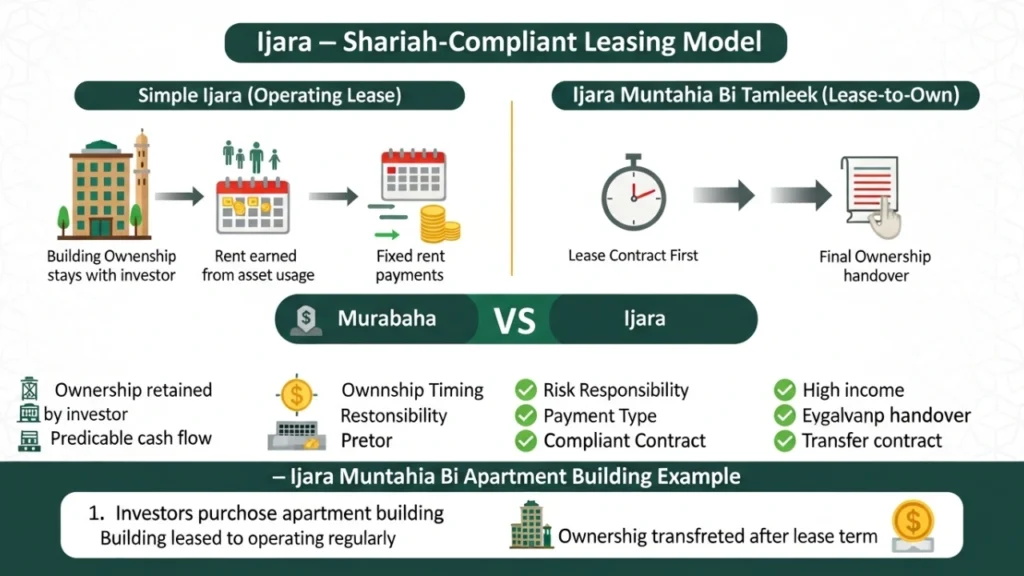
Ijara is the Islamic contract for leasing or renting an asset. It is an extremely popular and simple model for generating predictable, ethical returns from tangible assets.
- Simple Ijara (Operating Lease): This contract is simply a lease agreement. The lessor (investor/Halalvest) retains ownership of the asset (e.g., machinery, a building) and leases it to the lessee (client/tenant) for a fixed rental payment over a specified term. The rental income is the profit, and since it is earned from the use of a tangible asset, it is Shariah-compliant.
- Ijara Muntahia Bi Tamleek (IMBT) (Lease-to-Own): This is a more complex structure where the lease culminates in the transfer of ownership of the asset to the lessee at the end of the term. The transaction has two separate contracts executed sequentially: an Ijara contract (the lease) and a separate contract (often a gift or sale) for the transfer of ownership. This separation ensures the rent paid during the lease term is not confused with interest on a loan for the eventual purchase.
| Feature | Murabaha (Cost-Plus Sale) | Ijara (Lease) |
| Contract Type | Sale (immediate ownership transfer) | Lease (ownership stays with lessor) |
| Ownership | Transfers immediately to the client | Stays with Halalvest/investor during the term |
| Risk | Price fixed upfront, seller takes initial risk of purchase | Halalvest bears maintenance/asset risk during the lease |
| Installments | Repayment of a fixed, higher sale price | Rent for the use of the asset |
Halalvest in Action: Ijara Muntahia bi Tamleek (Apartment Building Acquisition)
IMBT is particularly effective for acquiring significant, stable, income-generating assets like apartment buildings, providing investors with steady rental income and a structured exit.
Scenario: Halalvest Investors fund the purchase of a 100-unit apartment building.
- Halalvest as Lessor: Halalvest Real Estate LLC, on behalf of its investors, purchases and retains full legal ownership of the apartment building.
- IMBT Agreement: Halalvest enters into an Ijara Muntahia bi Tamleek agreement with an operating entity (the client/lessee) for a fixed term (e.g., 7 years).
- Rental Income: The operating entity pays Halalvest a periodic (monthly/quarterly) rental fee for the use of the asset. This rental fee is the direct, compliant return for the investors, generated from the usage of the tangible asset.
- Ownership Transfer: At the end of the 7-year term, and provided all rental payments have been made, Halalvest separately executes a deed of transfer (e.g., a token sale or gift) to transfer the full ownership of the apartment building to the operating entity.
This structure makes the investment tangible and accessible because returns are derived from real-world rents paid by tenants. It ensures investors receive regular, compliant cash flow while maintaining ownership and control over a solid real estate asset for the life of the lease.
Istisna: Building Your Halal Portfolio
How Istisna Works (The Manufacturing/Construction Contract)
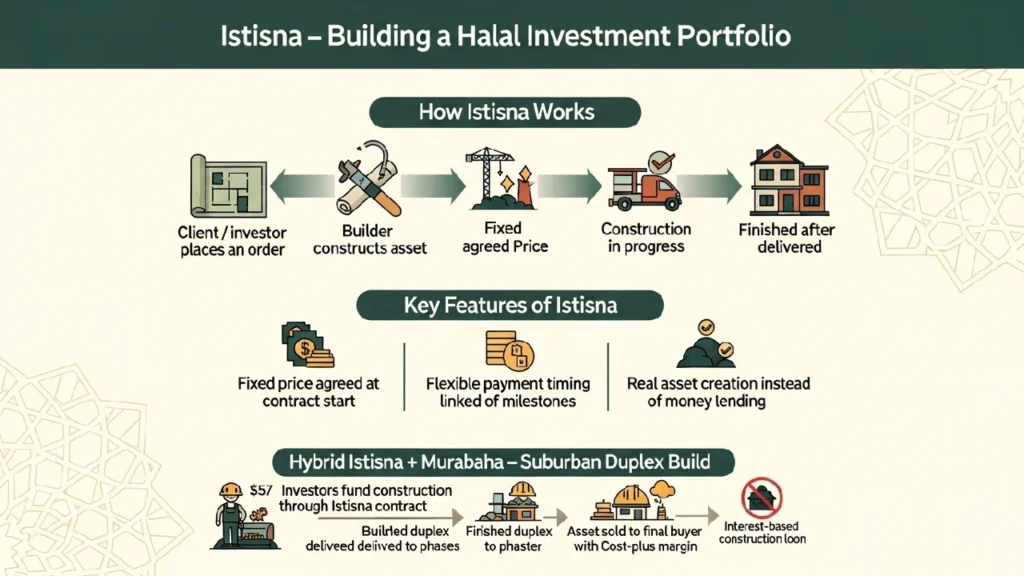
Istisna is a specialized Islamic contract primarily used for manufacturing, construction, or customized production. It is a purchase order where the seller (manufacturer/builder) agrees to produce or construct a specific asset for the buyer (client/investor).
- Definition: It is a contract where a client asks a manufacturer or builder (in our case, Halalvest’s construction partners) to construct or deliver an asset that is specifically defined, but not yet in existence (e.g., a custom home, a specialized piece of equipment, or a commercial development).
- Flexibility: The payment terms are highly flexible. The price is fixed at the time of the contract. Still, the payment can be made upfront, in installments based on construction milestones, or entirely deferred until the asset is completed and delivered. This flexibility makes it ideal for large-scale, long-term construction projects.
- Compliance: Unlike a conventional loan for construction, Istisna ensures that investors are funding the creation of a tangible asset, not just lending money at interest. The profit is the margin between the cost of construction and the fixed price agreed upon with the client.
Halalvest in Action: Hybrid Istisna + Murabaha (Suburban Duplex Build)
Halalvest utilizes a hybrid approach to make new construction projects, like building a suburban duplex, entirely Shariah-compliant from the moment the ground is broken.
- Istisna Component (Construction): Halalvest (on behalf of its investors) enters into an Istisna contract with a reputable construction firm. Under this contract, Halalvest is the buyer and agrees to pay a fixed price to the builder upon the successful completion of the duplex according to agreed-upon specifications and timelines. Halalvest funds the construction costs in phases. This ensures compliance with all construction funding being tied to progress and the ultimate creation of the asset.
- Murabaha Component (Financing/Sale): Simultaneously, Halalvest has an agreement with a final buyer (or operating partner) who wishes to acquire the finished duplex. Once the duplex is completed, Halalvest (who owns the asset upon delivery from the builder) sells it to the final buyer using a Murabaha structure. The sale price is the cost of the build plus an agreed-upon, compliant profit margin, payable over time.
This layered structure is perfect because it guarantees compliance from the ground up:
- The Istisna phase ensures the money invested is tied to manufacturing/construction (not just an interest-bearing loan to the builder).
- The Murabaha phase ensures the final transfer of the asset to the end-user is a riba-free sale, locking in the final profit for the investors. The investors benefit from the appreciation and the sale margin of a brand-new, purpose-built asset.
Venture Capital & Private Equity: Halal in High-Growth
Is Venture Capital Halal? (Structuring a Compliant Startup Investment)
The question, “Is venture capital halal?” is common among Muslim investors looking for high-growth potential. The direct answer is Yes, but it is entirely dependent on how the investment is structured and what the underlying business activity is.
Conventional venture capital (VC) and private equity (PE) often raise red flags due to potential involvement in debt-based financing or interest-bearing instruments. However, it is possible to achieve high-growth returns while remaining compliant.
Structuring a Halal Startup Investment:
To make VC and PE Shariah-compliant, investors must structure the funding using Islamic partnership contracts:
- Musharakah (Partnership): This is the ideal structure where the VC/PE fund (or Halalvest) invests capital in exchange for equity ownership in the startup. Both the fund and the entrepreneurs share the risks and the rewards proportionally to their partnership agreement. The entire investment is asset-backed by the company’s equity, making the returns earned from legitimate trade and business growth.
- Mudarabah (Trustee Finance): Here, the fund acts as the Rabb-ul-Maal (capital provider), and the startup’s founders act as the Mudarib (managers/expertise provider). The profit is shared, but the financial loss is borne only by the fund, offering a layer of protection to the entrepreneurs.
These equity-based models avoid the use of Riba, fulfilling the primary requirement. Furthermore, the investment must pass an Ethical Screening to ensure the startup is not involved in prohibited industries (e.g., alcohol delivery, conventional lending platforms, or gambling). Funds following these rules are known as Sharia compliant private equity funds, allowing investors to access the high-growth sector ethically.
The Future of Halal Investing: REITs and Beyond
Why a Halal REIT Matters (Comparison of Halal Equity Funds)
A Real Estate Investment Trust (REIT) is a company that owns, operates, or finances income-producing real estate. They allow investors to pool capital to invest in large-scale properties without having to buy them directly.
A Halal REIT is crucial because it resolves many of the compliance issues found in traditional investment vehicles, offering a compelling alternative in the comparison of halal equity funds.
Direct Asset-Backed Investment: Unlike many conventional halal equity funds that invest in public stocks (which must constantly be screened for Riba and non-compliant revenues), a Halal REIT’s returns are directly tied to tangible, income-producing real estate assets.
Shariah Compliance via Screening and Purification:
- Asset Screening: The properties must not be used for prohibited activities (e.g., a bar, a casino, a conventional bank office).
- Income Purification: While the assets are generally compliant, sometimes a minor amount of non-compliant income (like interest on a security deposit or rent from a non-compliant tenant) may be unavoidable. Halalvest’s model ensures this small portion is identified and purified (donated to charity) before distribution to investors.
REIT + Musharakah Structure: Halalvest structures its real estate investments, which mimic a REIT, often using the Musharakah (partnership) model. Investors contribute capital and share in the rental income, operational profits, and eventual sale gains of the properties, ensuring that returns are based on genuine profit-and-loss sharing from a tangible asset.
Halalvest’s Unique 12-Model Approach
To cater to diverse investor needs and market opportunities, Halalvest does not rely on a single structure. We offer a depth of investment strategies utilizing 12 proprietary models, including:
- Residential Fix & Flip (Hybrid Musharakah/Mudarabah)
- Suburban Duplex New Build (Hybrid Istisna/Murabaha)
- Multi-Family Renovation (Ijara)
- Commercial Building Acquisition (Murabaha)
This diversity provides investors with tailored, optimized solutions for different risk appetites and time horizons, all within a compliant framework.
Highlight the Halalvest Advantage
Choosing Halalvest Real Estate LLC means you no longer have to choose between your faith and your financial future. We combine spiritual peace with aggressive growth potential:
| Advantage | Benefit to Investor |
| 20%-50% Below Market Value | The Financial Incentive: We source deals at significant discounts, maximizing capital appreciation from the start. |
| Professionally Managed | The Peace of Mind: A team of U.S. real estate experts handles all the acquisition, management, and exit strategies. |
| Shariah-Certified | The Spiritual Safeguard: Every deal is screened, structured, and overseen by independent Shariah scholars to eliminate Riba and ensure full compliance. |
Practical Next Steps for the American Investor
Zakat Calculation for Your Halalvest Portfolio
A holistic commitment to Islamic finance extends beyond just earning Halal returns; it includes purifying and distributing a portion of that wealth annually through Zakat. This step shows a commitment to the communal aspect of wealth in Islam.
Zakat is an annual obligation on wealth (a minimum of 2.5% of net assessable assets) held for a lunar year above a certain threshold (Nisab). Calculating Zakat for a Halalvest investment portfolio depends on the underlying structure:
| Halalvest Model Type | Zakat Calculation Method | Notes |
| Real Estate (Musharakah/Ijara) | Zakat on Rental Income (Profits) | Zakat is due on the net profits (rental income) accrued over the year, not on the capital value of the real estate itself. |
| Fix & Flip (Musharakah/Istisna) | Zakat on the Total Capital + Profits | Since the assets (the houses) are considered trading goods intended for quick resale, Zakat is generally due on the entire portfolio value (capital + accumulated profits) at the Zakat due date. |
Simple Rule of Thumb: For most equity-based investments like those used by Halalvest, you should calculate 2.5% of the total amount of invested capital plus any accumulated, undistributed profits (or simply the net worth of the portfolio) held for a full lunar year. Consult with a Shariah scholar for precise application to your specific assets.
Avoid The Pitfalls: Best Halal Peer-to-Peer Lending Platforms
In your search for compliant investment options, you may encounter Halal Peer-to-Peer (P2P) Lending Platforms. While these platforms aim for compliance, investors should understand the key differences and inherent risks compared to a fully asset-backed real estate investment like Halalvest.
- P2P Structure: Many Halal P2P platforms use a Mudarabah or Murabaha structure to facilitate compliant personal or business financing. Instead of an interest rate, they charge a pre-agreed profit margin or share in the business profit.
- The Caution: While compliant in structure, P2P lending platforms often involve financing for intangible assets, services, or small business working capital, which can be inherently riskier than real estate. The returns are reliant on the financial stability of the individual or small business borrower, often without significant collateral.
- Halalvest’s Advantage: Halalvest Real Estate LLC offers a more secure alternative. Your investment is always backed by tangible, appreciating U.S. real estate. Instead of relying on a borrower’s credit score, your returns are tied to a physical asset’s rental income, operational profits, and market value—offering greater stability and security. Asset-backed security is the ultimate differentiator.
Secure Your Future: Start Your Halal Real Estate Journey Today
You’ve seen how easy it is to navigate the world of ethical investment when you have the right structures in place. We’ve broken down the maze:
- The Murabaha model offers a transparent, cost-plus sale for compliant financing.
- The Musharakah and Mudarabah contracts let you engage in true partnership, sharing risk and reward in high-growth ventures like fix-and-flips.
- The Ijara (Leasing) structure provides steady, asset-backed rental income.
- Finally, the Halal REIT approach offers diversified, accessible ownership of tangible real estate, purifying returns from non-compliant sources.
These structures aren’t just academic concepts; they are the spiritual and financial safety nets that protect your wealth from the pitfalls of Riba.
Don’t let the uncertainty of traditional finance keep you from achieving the financial growth your family deserves.
The market is waiting, and ethical opportunities are available. Stop worrying about complicated screenings and hidden interests. Partner with a company that protects your capital and your commitment to faith. Halalvest Real Estate LLC is built on the foundation of the very principles you value, offering you assets secured at 20%-50% below market value and managed by U.S. real estate veterans.
Ready to see how to structure halal real estate investments that align with your values?
Book a consultation with one of our Shariah-certified investment specialists today. Let Halalvest Real Estate LLC turn your commitment into profit.
Serving Muslim investors across the USA with integrity and expertise.
FAQs
1. How do Shariah Supervisory Boards (SSBs) or Scholars ensure the Halal compliance of a company like Halalvest LLC on an ongoing basis?
SSBs (also called Shariah Scholars) act as independent oversight bodies. Their role is not just to initially approve the investment models but also to periodically audit the firm’s operations, contracts, and financial transactions. They issue binding rulings (Fatwas) to ensure the company strictly adheres to the approved Shariah contracts (like Musharakah or Ijara) and that there is proper purification of any minor, unavoidable non-compliant income before profit distribution to investors. They essentially perform a Shariah compliance check on the company’s annual activities.
2. What are the general minimum investment requirements and typical fee structures for a Halal real estate fund like Halalvest LLC?
While the specific amounts vary by fund and project, Halal real estate funds typically require a higher minimum investment than publicly traded mutual funds, often starting in the range of $5,000 to $25,000 or more for specific deals. The fee structure usually involves a management fee (a percentage of the capital managed, e.g., 1-2% annually) “…and a performance fee or profit-share (e.g., the manager receives an agreed share of actual realized profits, subject to Shariah-approved profit-sharing terms, without any guaranteed or minimum return
3. Since Riba is forbidden, how are risks like tenant default or asset damage handled in Halal real estate structures like Ijara (leasing)?
In Halal contracts, risk must be shared because profit justifies risk. In an Ijara (leasing) contract for real estate, the Lessor (Halalvest/investor) typically bears the risk associated with the ownership of the asset, such as major maintenance, structural repairs, or loss due to fire/damage (covered by Halal Takaful/insurance). The Lessee (tenant/operating partner) typically bears the risk associated with the use of the asset, such as minor maintenance and utility costs. If a tenant defaults, the rental income stops, and the loss of rent is borne by the investors, unlike a conventional loan where the fixed interest payment is still legally due.
4. What is the difference between an ‘Asset-Backed’ and an ‘Asset-Based’ Halal financial instrument, and why does Halalvest focus on tangible assets?
An Asset-Backed instrument means the return and repayment are directly generated by the cash flow of the underlying asset (e.g., rental income from an apartment building). If the asset fails, the investor loses money. This is the preferred method for Musharakah/Mudarabah. An Asset-Based instrument means the asset’s value covers the principal. Still, the returns may not be directly sourced from the asset’s performance, making it closer to a debt instrument with the asset as collateral. Halalvest focuses on Asset-Backed investments because they represent genuine ownership and risk-sharing, tying investor returns directly to the real economic activity and performance of the property.
5. Is the Tawarruq (Commodity Murabaha) contract considered Halal for financing, and why do some scholars criticize it?
Tawarruq (often called Commodity Murabaha) is a complex financing tool where a customer buys a commodity on credit and immediately sells it to a third party for cash. The goal is to obtain immediate liquidity (money) without taking an interest-based loan. While many global Shariah boards permit the contract, provided all three sales are legitimate and involve full possession of the commodity, some conservative scholars criticize it because the ultimate intention is not to trade the commodity but solely to obtain cash at a higher deferred cost, essentially mimicking an interest-bearing loan by using a series of sales as a legal maneuver (Hillah).
Halalvest primarily avoids Tawarruq for real estate investment, preferring accurate equity- and leasing-based models like Musharakah and Ijara.

About the Editor
Mufti Qari Muhammad Jehangir TareenMufti Qari Muhammad Jehangir Tareen is a respected Islamic scholar specializing in Shariah compliance, Islamic finance, and the application of classical jurisprudence to modern investment structures. He has extensive experience reviewing real estate investment models and educational content to ensure alignment with Islamic principles. His work emphasizes the avoidance of riba, excessive gharar, and maysir, while promoting asset-backed, transparent, and ethical risk-sharing frameworks. Mufti Jehangir is well-versed in Shariah-compliant structures such as Musharakah, Mudarabah, Murabaha, Ijara, and Istisna. His reviews focus on proper contractual execution and clear communication to avoid any implication of guaranteed returns. And Allah knows best.