
 Google AI
 ChatGPT
 Perplexity
Finding financial opportunities in the USA that align with spiritual values can be a real challenge for conscientious investors. You want strong economic growth, but you also need assurance that your investments uphold the principles that matter most to you.
The Core Conflict: Interest and Ethics
The most significant difference between Halal and conventional investments lies in a core principle: the prohibition of interest (Riba). This prohibition isn’t just a minor regulation; it’s a foundational element of Islamic investment.
The problem is that many common, lucrative real estate ventures, traditional mortgages, and standard venture capital funds are fundamentally built upon this concept of Riba. This means that a large portion of the US investment landscape is simply inaccessible to those seeking a Halal portfolio.
Why This Conversation Matters Now: A Shariah-Compliant Shift
We are witnessing a significant and rising awareness and demand for Halal investing in the United States. Investors are no longer willing to choose between their faith and their investment; they are actively seeking solutions that allow them to pursue both.
This is why Halalvest Real Estate LLC exists. We are committed to bridging that gap—serving as your trusted guide and solution provider to navigate the US market with fully Shariah-compliant real estate investment opportunities.
Difference between Halal and Conventional Investments: The Foundational Key
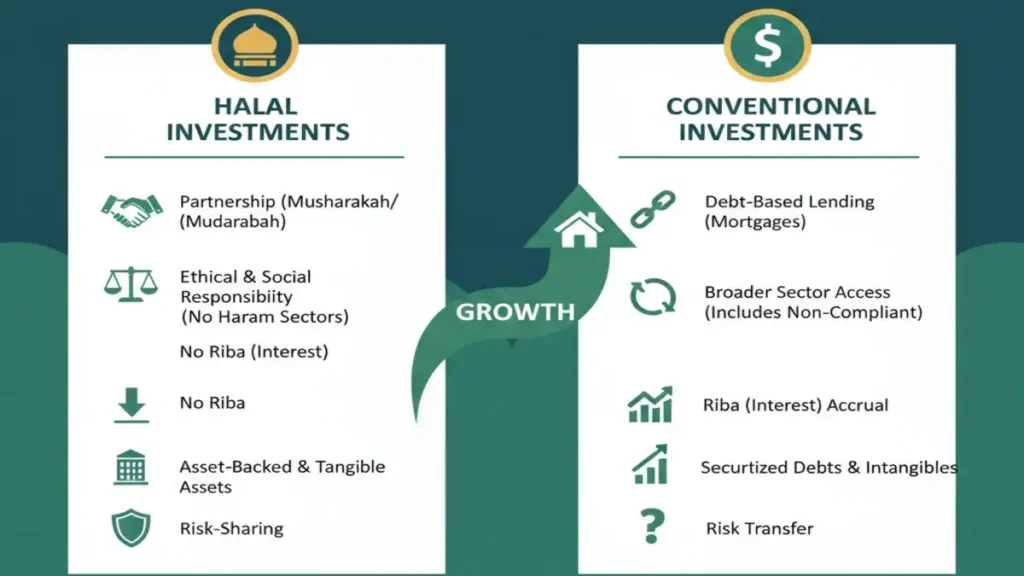
The distinction between Halal and conventional investments isn’t about complexity; it’s about adherence to core ethical and financial principles. Halal investment is defined by three primary prohibitions that fundamentally reshape the investment model.
Principle 1: Understanding Riba in Halal vs. Conventional Investment
Riba Defined
Riba is an Arabic term often translated as interest or usury. In Islamic investment, it refers to any excess or predetermined compensation in addition to the principal amount of a loan. It is strictly prohibited (Haram) because it is viewed as an exploitative form of gain that increases wealth simply by lending money, rather than through productive effort, trade, or genuine risk-sharing. This practice is believed to promote economic injustice and inequality.
Conventional Contrast
The entire structure of traditional banking and conventional investment is fundamentally built around the concept of Riba.
- Mortgages, bonds, and fixed-rate loans are all contracts where the lender is guaranteed a fixed, positive return (interest) regardless of whether the borrower makes a profit or suffers a loss.
- This places the entire risk on the borrower while ensuring a guaranteed, risk-free profit for the financier, which is the very essence of Riba.
Principle 2: Ethical Considerations (Gharar & Maysir)
Halal’s Focus
Halal investing goes beyond just prohibiting interest by introducing two other critical ethical screens:
- Gharar (Excessive Uncertainty/Risk): This prohibits transactions with excessive ambiguity, deception, or uncertainty regarding the subject matter, price, or terms. The goal is to ensure all transactions are transparent, fair, and mutually beneficial. Excessive speculation and complex financial derivatives (like certain futures or options) are often prohibited due to their inherent Gharar.
- Maysir (Gambling): This prohibits activities where gain comes solely from chance or speculation without a productive contribution, essentially banning all forms of gambling.
Halal investing is more ethical than conventional because it systematically excludes industries and practices considered harmful or exploitative (e.g., alcohol, tobacco, gambling, pornography, traditional financial services) and mandates transparency and genuine business backing for all deals.
Conventional Contrast
Conventional finance has significantly more flexibility:
- Speculative Ventures: While risk is inherent, the traditional system often facilitates high-stakes, zero-sum speculative trading and complex derivatives that may contain elements of Gharar and Maysir.
- Non-Compliant Sectors: Traditional stock markets and mutual funds routinely include investments in industries explicitly prohibited by Shariah law, such as those related to alcohol, pork products, conventional interest-based financial institutions, and adult entertainment.
Principle 3: Risk-Sharing and Partnership (Equity vs. Debt)
Halal Model: Genuine Partnership
The Halal model is based on asset-backed, profit-and-loss sharing rather than debt. This creates a genuine partnership between the investor and the entrepreneur/venture.
- Musharakah (Joint Venture): All partners contribute capital, and profits/losses are shared according to a pre-agreed ratio (often based on their respective contributions).
- Mudarabah (Trustee Finance): One party provides the capital (investor), and the other provides the management and labor (entrepreneur). Profits are shared, but losses are borne entirely by the capital provider (unless due to the manager’s negligence).
- The investor is a partner who shares the risk and reward, directly linking the financial return to the real economic performance of the underlying asset or business.
Conventional Model: Guaranteed Return (Debt)
The conventional model is dominated by debt financing (loans, mortgages, bonds).
- The financier (bank/lender) is primarily a creditor, not a partner.
- The financier is guaranteed a fixed return (interest), which must be paid regardless of whether the borrower’s venture succeeds or fails.
- The conventional system thus focuses on risk transfer (to the borrower) and debt creation, leading to high leverage and systemic risk.
Halal Real Estate Investment vs. Conventional Property: Turning Principles into Profit
The principles of Halal finance aren’t limitations; they are the foundation for more stable, equitable, and ultimately profitable investment structures in the real estate sector. This section demonstrates how we turn these principles into tangible, Shariah-compliant profit.
The Conventional Way: The Riba-Based Mortgage Trap
Consider a typical US home purchase. An investor buys a $500,000 property using a conventional mortgage.
- The bank provides the loan and charges a fixed interest rate of 6% for a term of 30 years.
- Regardless of whether the property value soars or crashes, or whether the tenant pays the rent, the investor must pay the principal plus the $6,000, $10,000, or more in annual interest.
- The bank’s return is guaranteed before any real profit is realized, isolating them from the operational risk while maximizing their gain—a direct manifestation of Riba.
Halal Alternatives: Introducing Shariah-Certified Investment Models
At Halalvest Real Estate LLC, we structure our deals using specific Shariah-compliant contracts. We ensure that every transaction is based on the purchase and sale of a real, tangible asset, with risks and rewards shared equitably.
Musharakah (Partnership/Equity Financing):
- Concept: A joint venture where the investor and Halalvest (or another partner) contribute capital to purchase the property and share the profits and losses based on their ownership stakes.
- Real-World Example: Our Hybrid Musharakah + Mudarabah (Residential Fix & Flip) model. Halalvest provides the expertise (Mudarabah effort) and co-invests capital (Musharakah), while the investor offers the majority of the capital. Both parties share the risk of a market downturn and split the final profit from the sale, aligning all incentives.
Murabaha (Cost-Plus Financing):
- Concept: The institution (Halalvest) purchases the asset the client desires and then sells it to the client based on the actual cost plus a mutually agreed markup, without pre-specifying a fixed profit, in compliance with Shariah. The total price is agreed upfront, but profit is not guaranteed or fixed.
- Real-World Example: Our Hybrid Murabaha + Mudarabah (Retail Building Purchase) model. Halalvest purchases a retail building and immediately sells it to the client for a higher, fixed price (the total of which is paid in installments). Halalvest may then manage the property (Mudarabah effort) for a percentage of the rental income, providing an ethical revenue stream.
Ijara (Leasing/Rental):
- Concept: Similar to a conventional lease, where the financier (Halalvest) owns the asset and leases it to the client for a fixed rental fee. The fee is based on the value of the asset and usage, not an interest rate.
- Real-World Example: Our Ijara Muntahia Bi Tamleek (Lease-to-Own) (Apartment Building Acquisition) model. Halalvest buys the apartment building and leases it to the client. A portion of each lease payment goes towards the eventual purchase price of the building, with ownership gradually transferred to the client by the end of the term.
Istisna (Construction/Manufacturing Finance):
- Concept: A contract to finance the construction or manufacturing of an asset according to agreed-upon specifications. Halalvest takes the construction risk. Profit is based on the final realized value of the completed asset, not pre-fixed.
- Real-World Example: Our Hybrid Istisna + Murabaha (Suburban Duplex Build) model. Halalvest finances and oversees the construction of a new duplex (Istisna). Once complete, the duplex is sold to the investor under a Murabaha (cost-plus sale) contract with payment installments reflecting actual realized value, ensuring the return is Shariah-compliant.
Shariah-Compliant REITs:
- Concept: Halalvest creates and manages REITs (Real Estate Investment Trusts) whose underlying assets and financial structure are strictly screened to avoid Riba and prohibited sectors.
- Real-World Example: Our REIT + Musharakah (Mixed-Use Multifamily REIT) model. The fund holds only income-producing, Shariah-compliant real estate (e.g., apartments, warehouses). The investment into the fund is structured as a Musharakah (equity partnership). The investor’s return is a share of the actual rental profits, not guaranteed interest, ensuring compliance while capturing the growth potential of US commercial real estate.
Performance Comparison: Halal vs. Conventional Funds—Dispelling Myths
The misconception that Shariah-compliant investing requires sacrificing ROI is a significant hurdle for many investors. In reality, the strict ethical and financial screens imposed by Halal principles often lead to more stable, long-term performance than conventional funds, especially during periods of market volatility.
Advantages of Halal Investment Over Conventional Banking
The disciplined constraints of Halal investing are, paradoxically, its most significant competitive advantage, offering a distinct edge over conventional strategies:
- Stability through Screening: By prohibiting investment in volatile, debt-ridden sectors and speculative instruments (Gharar), Halal funds inherently avoid the high-leverage and interest-rate risks that devastate conventional markets during downturns. Research often shows that Shariah-compliant indices decline less steeply than conventional benchmarks during financial crises.
- Focus on Real Assets: Halal investment mandates asset-backed transactions, diverting capital from risky paper assets to tangible, productive investments such as real estate and ethical businesses. This ties directly to real economic growth.
- The Halalvest Competitive Edge: We don’t rely solely on ethical screening; we incorporate a rigorous acquisition strategy. We identify and acquire high-quality, distressed properties at 20%–50% below market value. This aggressive value-add approach, combined with compliant financing, creates a substantial, built-in profit margin that ensures superior returns without resorting to Riba.
Risk Profiles: Halal Versus Traditional Investments
The fundamental difference in financing structures translates directly into a different, often more conservative, risk profile for Halal investments:
| Feature | Halal (Equity/Risk-Sharing) | Conventional (Debt-Financing) |
| Exposure to Debt | Inherently Limited: Shariah financial screens impose strict limits on leverage (interest-bearing debt), often capping debt-to-asset ratios at 30% or less. | Unlimited: Highly reliant on loans, mortgages, and leverage; debt-to-equity ratios can be extremely high, increasing fragility. |
| Risk Bearing | Shared: The investor is a partner (Musharakah) and shares in the profit and loss. The capital provider bears losses in accordance with Shariah | Transferred: Borrower/Client bears the market risk, while the financier (bank) is guaranteed its return (interest) regardless of the venture’s success. |
| Stability in Downturns | More Stable: Lower leverage and avoidance of speculative assets mean less catastrophic exposure during recessions. | More Volatile: High leverage often amplifies losses, contributing to systemic risk and greater losses for the investor. |
By prioritizing equity-based, asset-backed investment over debt, the Halal model inherently limits exposure to catastrophic financial leverage, resulting in a more robust and potentially more stable portfolio that delivers ethical, Shariah-compliant growth.
How to Choose Between Halal and Conventional Investments (Beginner’s Guide)
Choosing your investment path reflects your priorities. For conscientious investors, the decision between Halal and conventional finance hinges on whether you seek profit at any cost, or prosperity with principle.
Your Path to Compliant and Prosperous Real Estate Investing
The Halal investment framework provides a path that safeguards both your capital and your spiritual commitments. By avoiding Riba, excessive debt, and harmful sectors, you are not merely filtering investments—you are choosing a superior, Shariah-compliant, and resilient economic model centered on risk-sharing and tangible assets.
This principled approach is already gaining massive traction in the US market: Over 1000 traditional brokers, officers, and investors are engaging with our platform and implementing our Halalvest models, demonstrating the credibility, scale, and Shariah-compliant financial viability of our solutions.
Partner with Halalvest Real Estate LLC: Secure Your Future Today
You do not have to become a Shariah law expert to build a compliant real estate portfolio. We are your end-to-end partner, offering comprehensive services that handle every step:
- Acquisition & Development: Identifying high-value, undervalued properties that fit our aggressive value-add criteria.
- Shariah-Certification: Structuring every transaction (Musharakah, Ijara, Murabaha) to ensure 100% compliance.
- Management: Overseeing the property or venture to maximize returns while maintaining ethical standards.
Ready to move from concern to confidence? Take the next step:
Book a private consultation with our Shariah-certified finance experts to find the right Halal investment for you.
Conclusion
The difference between Halal and conventional investments is not a limitation—it is a superior, principal-based model. Halal investing empowers you to build wealth through genuine partnership, shared risk, and tangible assets, aligning your faith with your investment.
It’s time to build a portfolio you can be proud of.
FAQs
1. What specific US real estate sectors are prohibited in Halal investing beyond just the financing model?
While the financing method (avoiding Riba) is crucial, the end-use of the property must also be Halal. Prohibited real estate sectors include properties used primarily for:
- Alcohol or Pork: Bars, breweries, or processing facilities.
- Gambling: Casinos or dedicated betting establishments.
- Adult Entertainment: Strip clubs or pornography production/distribution offices.
- Conventional Financial Services: Buildings primarily leased to non-Islamic banks, credit card companies, or traditional insurance firms that generate the majority of their income from interest.
Halal real estate typically focuses on residential, healthcare, industrial/warehousing, and compliant commercial office spaces.
2. Are the total costs and fees for a Halal real estate transaction (e.g., Murabaha) higher than those for a conventional mortgage?
The total cost of a Halal transaction may sometimes be perceived as higher than the principal amount of a conventional loan; however, this is a structural difference, not an additional fee.
- In a conventional mortgage, the cost is the principal plus fluctuating interest (also known as Riba).
- In a Halal Murabaha or Ijara model, the cost is the principal plus a fixed, pre-agreed profit margin or rental charge. This profit replaces the Riba and is determined upfront.
- Halalvest prioritizes transparency; however, the necessity of complex legal structuring and Shariah board approval can sometimes introduce marginally higher initial setup costs compared to standardized conventional loans.
3. If I am a non-Muslim, can I still invest in Halal real estate ventures like those offered by Halalvest Real Estate LLC?
Yes, absolutely. Halal investing is a form of ethical and socially responsible investing (SRI) that is open to individuals of all faiths and backgrounds. Non-Muslim investors are drawn to the Halal model because of its core benefits:
- Ethical Screening: It avoids morally questionable and exploitative industries.
- Financial Stability: It mandates lower leverage and is asset-backed, offering a potentially more stable risk profile.
- The only requirement is that the investor agrees to the Shariah-compliant contract terms (e.g., profit-sharing, no Riba).
4. How is Zakat (wealth purification) calculated and paid on Halal real estate investments?
The method for calculating Zakat depends entirely on the investor’s intent:
- For Rental Income Properties (Long-Term Hold): Zakat is generally not paid on the value of the property asset itself. It is paid at the rate of 2.5% on the net rental income (after expenses) that remains in the investor’s possession for a full lunar year (haul) above the Nisab (minimum threshold).
- For Fix-and-Flip Properties (Investment for Resale): The property is treated as trade goods, and Zakat is paid at the rate of 2.5% on the full market value of the property at the time the Zakat is due, along with any cash or inventory.
5. Do Shariah-compliant funds and real estate generally outperform or underperform conventional investments over the long term?
Studies comparing Shariah-compliant indices (like the S&P 500 Shariah Index) to conventional counterparts show that they often perform comparably over the long term, with a key distinction:
- Comparable Returns: Halal funds have historically provided returns that match or slightly exceed conventional funds over various long-term periods.
- Better Resilience in Crises: They often show greater resilience and lower volatility during market downturns (e.g., the 2008 Financial Crisis), precisely because they are forced to exclude highly leveraged and interest-sensitive financial institutions and speculative ventures.
- The exclusion of high-debt companies often results in a focus on financially sound and stable businesses.

About the Editor
Mufti Qari Muhammad Jehangir TareenMufti Qari Muhammad Jehangir Tareen is a respected Islamic scholar specializing in Shariah compliance, Islamic finance, and the application of classical jurisprudence to modern investment structures. He has extensive experience reviewing real estate investment models and educational content to ensure alignment with Islamic principles. His work emphasizes the avoidance of riba, excessive gharar, and maysir, while promoting asset-backed, transparent, and ethical risk-sharing frameworks. Mufti Jehangir is well-versed in Shariah-compliant structures such as Musharakah, Mudarabah, Murabaha, Ijara, and Istisna. His reviews focus on proper contractual execution and clear communication to avoid any implication of guaranteed returns. And Allah knows best.