 Google AI
 ChatGPT
 Perplexity
Finding affordable real estate in today’s housing market feels like an uphill battle. Prices stay high, and interest rates make conventional loans expensive. Many Muslim investors look for discounted properties to build wealth without compromising their faith.
Are you looking into buying foreclosures Shariah compliant with your faith? You are not alone. Thousands of home buyers, real estate brokers, and loan officers ask this exact question every day.
At Halalvest Real Estate LLC, we specialize in Shariah-compliant real estate opportunities. Our platform connects over 1,000 traditional brokers, loan officers, and investors across the United States. We identify and acquire distressed assets at 20% to 50% below market value. This includes bank repossessions and public auctions.
We created this complete guide to answer your questions about foreclosure investing. We will look at Islamic law, scholar opinions, market data, and practical halal solutions for your real estate journey.
Why Are Distressed Properties Rising in Today’s Market?
The real estate market is changing quickly across the United States. According to official property statistics from ATTOM, total foreclosure filings reached 227,548 properties in the first half of the year. Foreclosure starts rose 18% during the same period.
At the same time, economic data reported by Forbes shows that the Federal Reserve held interest rates between 3.50% and 3.75%. High conventional mortgage rates put pressure on everyday homeowners.
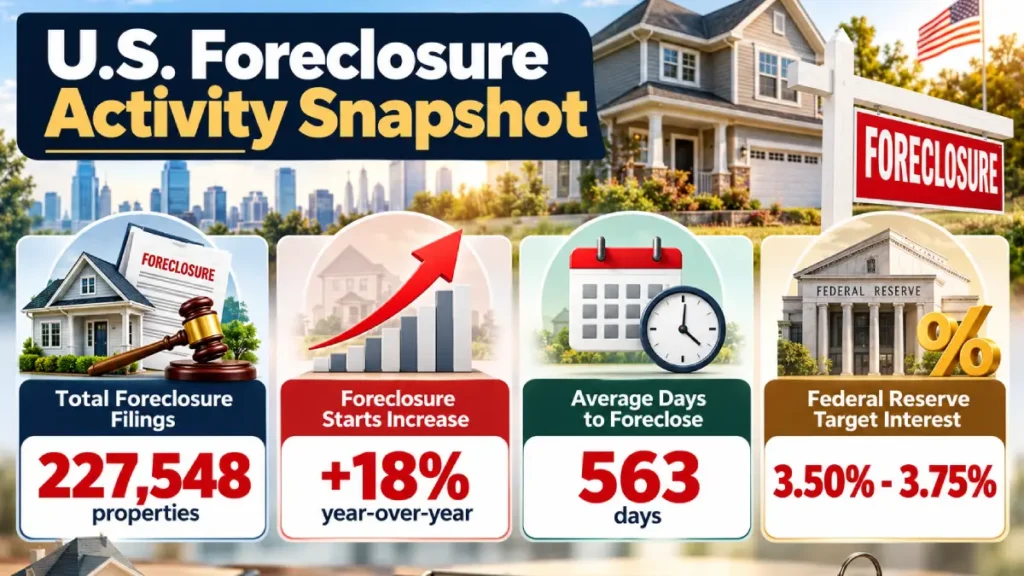
States like Texas, Florida, California, Georgia, and Illinois lead the nation in new foreclosure filings. Average foreclosure timelines dropped to 563 days, showing faster court liquidation cycles.
Almost 90% of distressed homeowners still hold positive equity in their properties. This high equity margin opens the door for ethical property acquisitions that protect value for buyers and sellers alike.
Is Buying Bank Foreclosures Permissible in Islam?
Many people wonder about the exact Islamic ruling on repossessed houses. Is it halal to buy a home that a bank took from someone else?
Buying a foreclosed property may be permissible in Islam when the property is lawfully owned and the foreclosure and purchase process comply with applicable Shariah principles.
Defining Foreclosure Mechanics and Property Ownership
A default happens when a homeowner stops making mortgage payments. The conventional lender takes the property to court to recover its money.
The Shariah ruling depends on the legal ownership, security arrangement, and foreclosure process; therefore, the bank’s right to sell the property should be examined according to the specific structure and applicable law.
When you buy a foreclosed home, you buy physical real estate. You are paying money for property, not buying or trading debt.
Classical Evidence: Public Auctions (Bay’ al-Muzayadah) in the Sunnah
Public auctions have deep roots in Islamic history. Classical Islamic law calls this process Bay’ al-Muzayadah.
In Sahih Bukhari (Hadith 2141 / Book 34, Hadith 351), Jabir bin Abdullah narrated a clear event from the life of the Prophet Muhammad ﷺ. A man declared his slave free after his death but later suffered severe debt.
Prophet Muhammad ﷺ took the slave and offered him to buyers at a public gathering. He asked:
“Who will buy this slave from me?”
Nu’aim bin Abdullah bought the slave for eight hundred dirhams. The Prophet ﷺ took that money and gave it directly to the debtor to pay off his debt.
Islamic scholar Hafiz Ibn Hajar al-Asqalani explained this narration in Fath al-Baari. He noted that liquidating property through public bidding is completely valid to settle real debts. Jurists across major Islamic schools agree that public sales protect creditor rights and resolve unpaid debts fairly.
Are You Exploiting Someone’s Misfortune?
Muslim buyers often feel guilty about buying a distressed home. They worry they are benefiting from another family’s financial pain.
Islamic finance views public auctions as a practical way to clear debt. When a property sells at auction, the sale proceeds pay off the debt.
Surah Al-Baqarah (2:280) in the Holy Quran encourages loan forbearance and relief for distressed debtors:
“And if someone is in hardship, then let there be postponement until a time of ease. But if you give from your right as charity, then it is better for you, if you only knew.”
Where the applicable legal and Shariah framework requires it, any surplus remaining after the valid debt and permissible costs have been settled should be returned to the person legally entitled to it.
What Do Islamic Scholars Say About Foreclosure Investments?
Understanding scholar rulings helps clear up doubts about repossessed homes.
Islamic Scholars’ View on Buying Foreclosed Homes
Some Islamic finance scholars have considered the purchase of foreclosed properties permissible when the underlying ownership, sale process, and transaction structure comply with Shariah principles. Dr. Monzer Kahf, a renowned expert in Islamic economics, explicitly states that buying foreclosures is permissible.
In some foreclosure procedures, the bank may have legally enforceable rights as a creditor, but the Shariah ruling depends on the specific ownership and foreclosure structure.
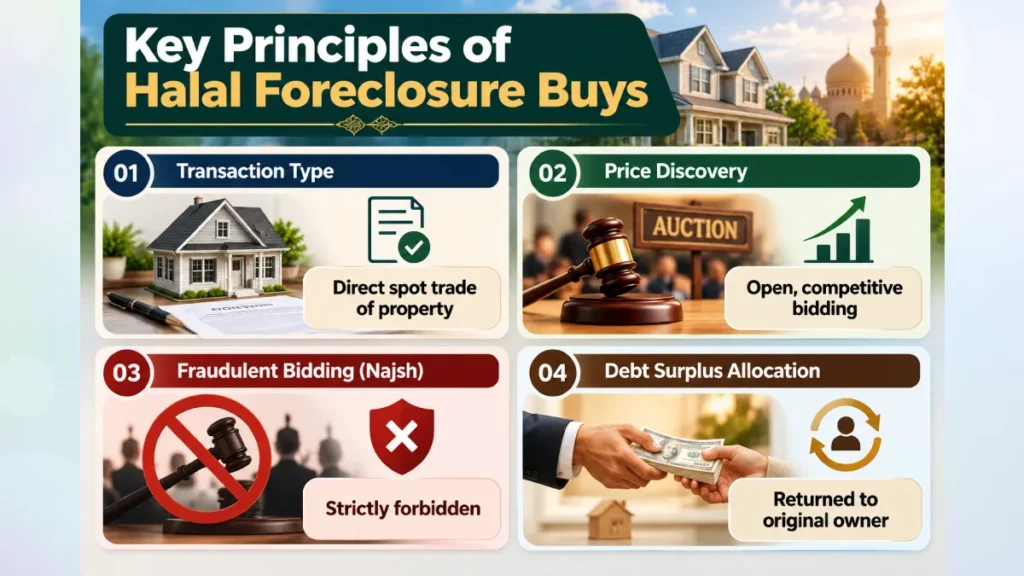
The seller must not use false bidding tactics to inflate prices. Islamic law calls fake bidding Najsh, and Prophet Muhammad ﷺ strictly forbade it in Sahih Bukhari (Hadith 2150).
Understanding Riba in Foreclosure Investments: An Islamic Perspective
Many buyers wonder: Does buying a foreclosed home mix your money with Riba (usury)?
Surah Al-Baqarah (2:275) makes a clear distinction between trade and usury:
“Allah has permitted trade and has forbidden interest.”
When the original homeowner took out a conventional mortgage, they signed an interest-bearing contract. That contract contained Riba.
When you buy that home at auction or from a bank inventory, you sign a new purchase agreement. You pay cash or use halal financing for the current market price. You do not take over the previous owner’s interest debt. Your new transaction stands completely separate from the old loan.
Buying Foreclosures Shariah Compliant: Legal Aspects and Financing Options
Navigating legal steps and financing rules requires clear planning.
Legal Aspects of Shariah Compliant Foreclosure Acquisition Comparing Traditional vs Islamic Foreclosure Financing
The legal process for foreclosures follows state property laws. Courts oversee property defaults, order public sales, and transfer title deeds.
Traditional foreclosure sales clear old mortgage liens from the property title. The buyer receives clear ownership through a court-approved deed.
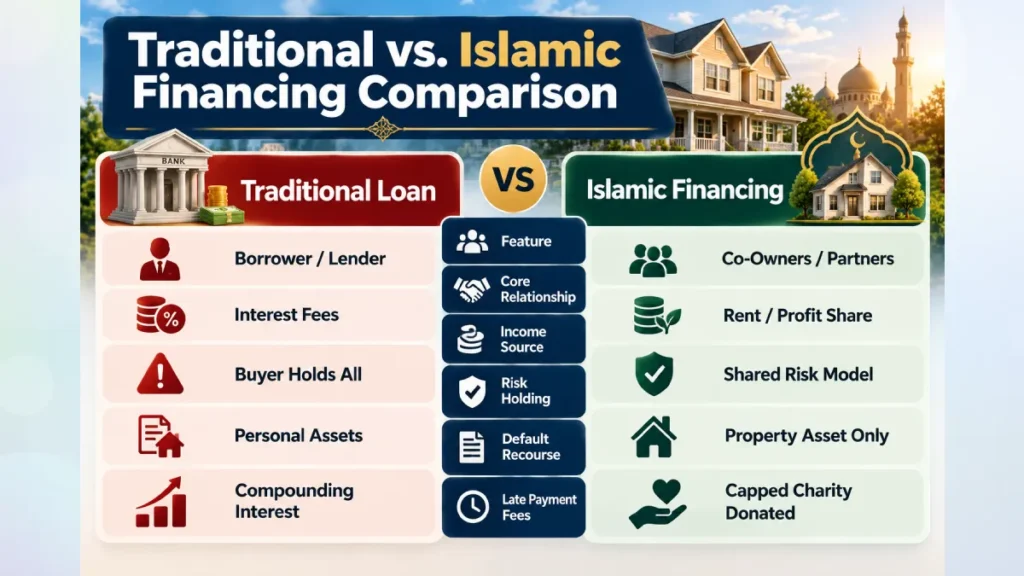
Islamic financing structures change the relationship between the buyer and the financial provider. Instead of a lender charging interest on money, the Islamic financial institution joins you as an equity partner or buys the house to resell it to you.
Traditional Mortgages vs. Shariah-Compliant Financing Models
If you need funding to buy a foreclosed property, conventional mortgages are out of the question. You need dedicated Shariah compliant financing for foreclosed homes.
Options like Islamic mortgage options for repossessed properties rely on asset-backed contracts. Common contracts include:
- Declining Co-Ownership (Musharakah Mutanaqisah): You and the institution buy the property together. You buy out their share over time while paying rent on the portion you do not own yet.
- Cost-Plus Sale (Murabaha): The institution buys the property outright and sells it to you at a fixed profit margin. You pay the total cost in fixed monthly installments.
- Lease-to-Own (Ijara Muntahia Bi Tamleek): Under a properly structured Ijarah arrangement with a promise of ownership transfer, the lease and the mechanism for transferring ownership must comply with the applicable Shariah requirements.
How Can You Find Halal Ways to Invest in Foreclosures?
Investing in foreclosed assets requires clear steps and reliable partners.
Halal Ways to Invest in Foreclosures: Step-by-Step Acquisition
Finding Halal ways to invest in foreclosures requires focus and organization. Follow this simple step-by-step approach when you evaluate deals:
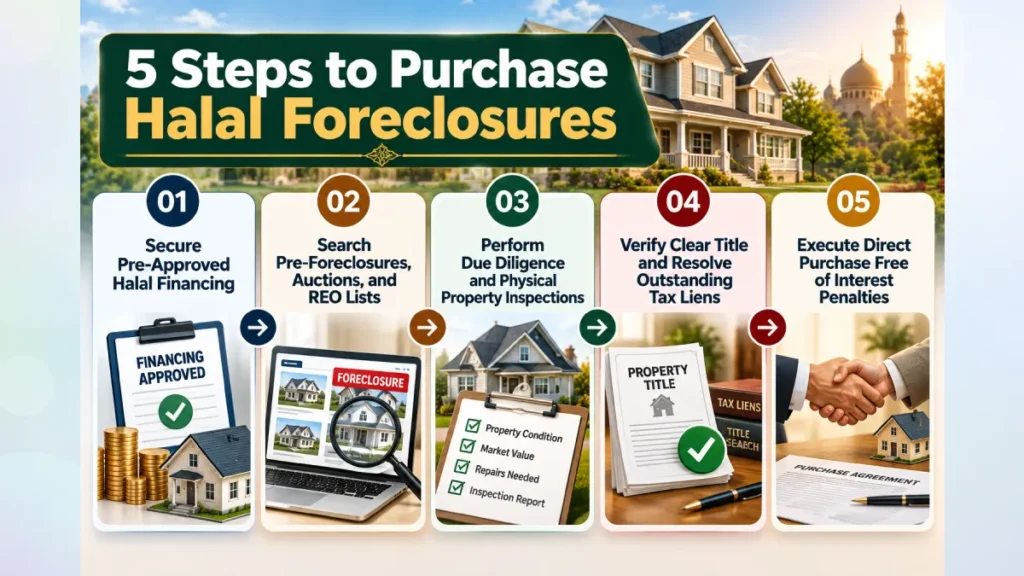
- Secure Halal Funding: Get pre-approved through a verified Islamic financial platform before looking at properties.
- Locate Distressed Assets: Search public county records, short-sale listings, and bank-owned property databases.
- Inspect Property Condition: Evaluate renovation needs to prevent unexpected costs (Gharar).
- Run Title Searches: Confirm the property has no hidden tax liens or secondary mortgages.
- Complete the Purchase: Buy the property directly through cash or an approved Islamic contract.
Following a clear guide to Shariah compliant foreclosure purchases keeps your investments ethical, profitable, and secure.
Shariah Compliant Alternatives to Traditional Foreclosure Investments
Many investors prefer hands-off property investments. Instead of managing individual fix-and-flip projects, they choose pooled funds or structured deals.
If you want Shariah compliant alternatives to traditional foreclosure investments, Halalvest Real Estate LLC offers 12 certified investment models tailored for Muslim investors:
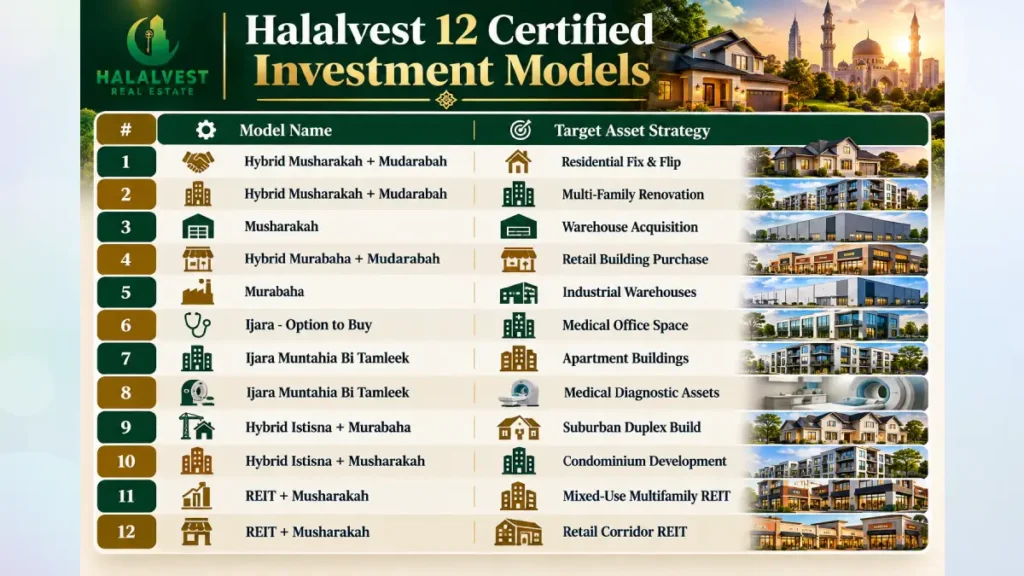
Learning how to buy foreclosures Islamically gives you full control over your financial future. You get access to institutional discounts while preserving your spiritual values.
What Are the Risks and Rewards of Distressed Property Investing?
Every property investment comes with opportunities and challenges.
Financial and Operational Rewards of Distressed Asset Purchasing
Understanding the risks and rewards of Islamic foreclosure investing helps you build long-term real estate portfolios.
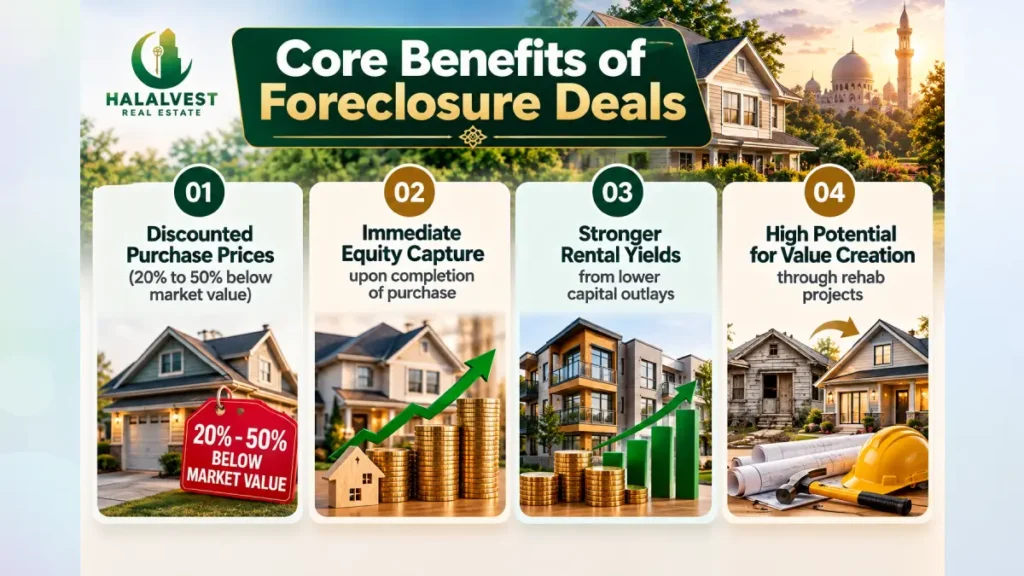
Participating in ethical investing distressed properties Islamic finance allows you to revitalize neighborhoods, improve housing quality, and create local jobs.
Key Risks: Property Condition, Encumbrances, and Mitigation Strategies
Distressed properties come with real operational risks. You must evaluate each project carefully to protect your investment capital:
- Unknown Structural Damage: Many foreclosed homes sit vacant for months without proper maintenance.
- Title Defects and Encumbrances: Unpaid municipal fines, contractor liens, or secondary debt can cloud title ownership.
- Occupancy Issues: Former owners or squatters may still occupy the property post-sale.
Mitigate these risks by working with experienced underwriting teams, conducting title searches, and setting aside cash reserves for unexpected repairs.
How Do You Connect With Halal Investors and Follow Best Practices?
Building networks and executing clean contracts ensures long-term success.
Finding Shariah Compliant Property Investors for Foreclosures
Are you looking for partners to expand your real estate business? Finding Shariah compliant property investors for foreclosures is much easier when you join specialized real estate networks.
Halalvest Real Estate LLC connects local real estate agents, loan officers, and private investors. Our platform matches active property deals with pre-screened capital sources. This helps brokers connect with potential capital sources while seeking to structure each transaction in accordance with applicable Shariah principles.
Best Practices for Shariah Approved Foreclosure Deals
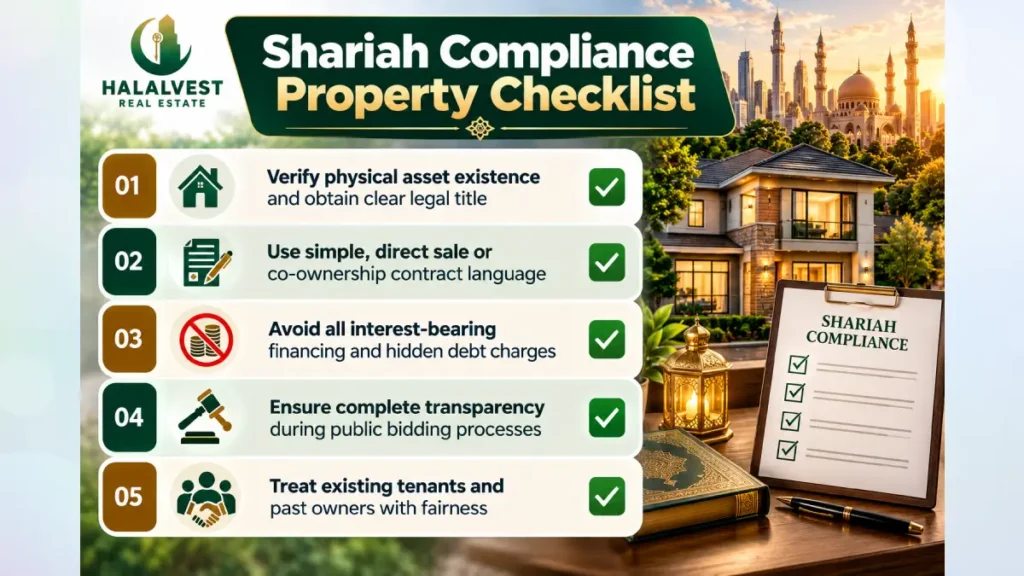
Follow these fundamental steps when executing best practices for Shariah approved foreclosure deals:
Final Thoughts on Buying Foreclosures Shariah Compliant
When it comes to buying foreclosures Shariah compliant choices empower you to build real wealth without sacrificing your faith.
Islamic jurisprudence provides clear rules for public auctions, asset-backed trades, and risk-sharing partnerships. By buying distressed properties at fair market values, you help resolve outstanding debts, upgrade local housing stock, and generate halal income for your family.
Are you ready to explore discount real estate deals in your target market? Connect with Halalvest Real Estate LLC today. Explore our 12 Shariah-certified investment models and join over 1,000 active real estate professionals building halal wealth across the nation.
Frequently Asked Questions
Can non-Muslims invest in Islamic foreclosure platforms?
Yes. Non-Muslim investors can freely participate in Shariah-compliant foreclosure platforms. These platforms focus on ethical equity sharing, direct asset ownership, and interest-free structures. Anyone seeking fair, transparent, and asset-backed real estate opportunities can join and invest.
Do Islamic foreclosure deals require larger down payments?
No. Islamic foreclosure financing does not automatically demand massive down payments. Some Shariah-compliant financing programs may offer relatively low down-payment options, subject to the provider’s eligibility criteria and the specific financing structure.
Are tax lien foreclosures considered halal in Islam?
Buying property through a tax-related foreclosure may be permissible when the underlying ownership, auction process, and rights being transferred comply with Shariah principles.
Can you rent foreclosed homes before full ownership?
Yes. You can rent a foreclosed home before full ownership through lease-to-own contracts like Ijara Muntahia Bi Tamleek. You make regular rental payments while building equity, eventually taking full legal title when the lease ends.
Do Islamic banks charge late fees on foreclosures?
No. Authentic Islamic financial institutions never charge compounding interest or profit-generating late fees on foreclosed contracts. Any capped administrative late fee charged for late payments goes directly to verified charities, keeping the entire transaction halal.