 Google AI
 ChatGPT
 Perplexity
Building a startup requires early capital. Many founders face tough money decisions during initial growth stages. Traditional financing options usually depend on high interest rates and compounding financial penalties.
If you want to grow without interest, Shariah compliant seed funding provides a clear path forward. This financial model protects your spiritual values while providing growth capital.
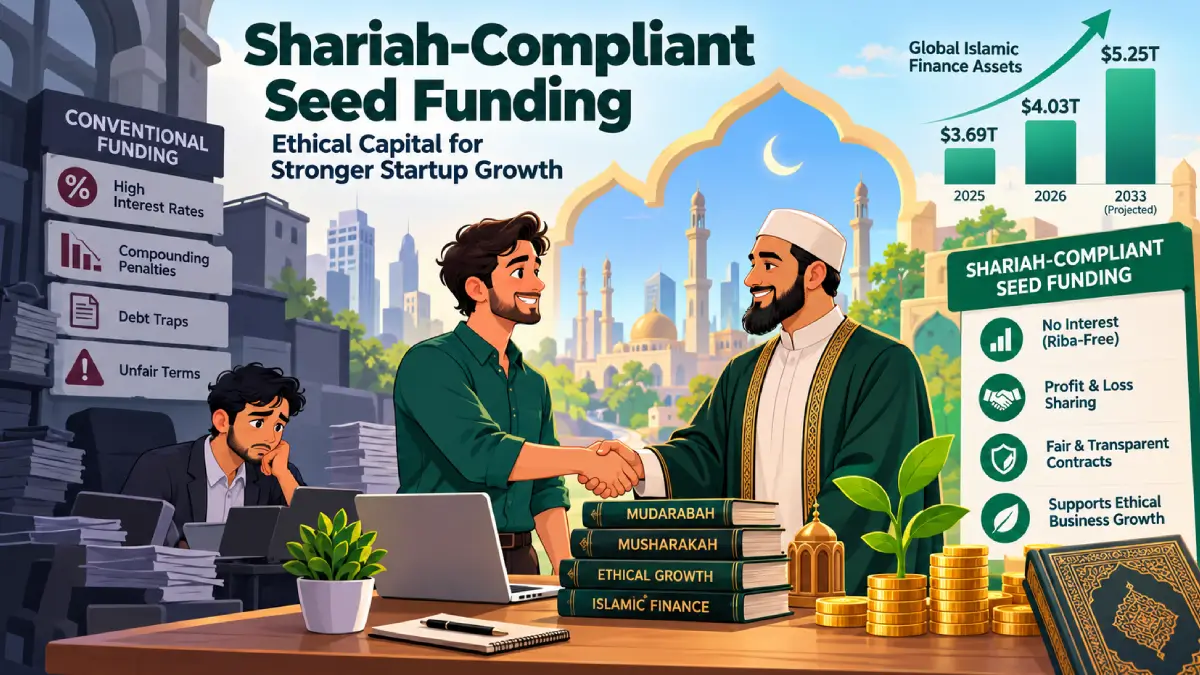
Global Islamic finance assets surpassed $3.69 trillion in 2025. Experts project this market to reach $4.03 trillion in 2026 and $5.25 trillion by 2033. Muslim consumer spending across global lifestyle and tech sectors exceeds $1.8 trillion. This growth creates massive demand for fair financial solutions.
Global Islamic Finance Growth (USD Trillions)
2025: $3.69 Trillion
2026: $4.03 Trillion
2033: $5.25 Trillion (Projected)
The Rise of Ethical Capital in Startup Growth
Why Traditional Seed Funding Creates Challenges for Muslim Founders?
Conventional startup funding relies on interest-bearing debt and convertible debt notes. Simple Agreements for Future Equity often include compounding interest rules. These terms violate core Islamic principles regarding money and trade.
Founders often feel trapped between business expansion and faith commitments. Traditional lenders shift all financial risk directly onto the business owner.
Here are three common points of friction with traditional startup capital:
- Fixed interest payments due regardless of business profit or loss.
- Liquidation preferences that penalize common stock owners during sales.
- Non-compliant debt conversion clauses embedded in standard investment agreements.
Finding ethical funding alternatives for startup growth helps founders avoid these debt traps. You can scale your business while keeping your cap table clear of interest.
Defining Shariah Compliant Seed Funding in Simple Terms
Shariah-compliant seed capital is risk-sharing equity for early-stage companies. Investors provide cash in exchange for direct profit shares or company equity.
This investment structure removes interest, hidden fees, and unfair risk transfers. Both parties share business gains and losses equitably.
Using a guide to Shariah-compliant pre-seed funding prepares your company for early investments. You get capital while following clear Islamic contract rules.
What Makes Shariah Compliant Seed Funding Different?
Core Prohibitions: Eliminating Riba, Gharar, and Maysir
Islamic commercial law focuses on fairness and direct transparency. Three main prohibitions govern all halal investment agreements:
- Riba (Interest): Charging or paying interest on loans is strictly forbidden.
- Gharar (Uncertainty): Contracts cannot contain vague terms or hidden asset conditions.
- Maysir (Gambling): Purely speculative deals without real assets or business operations are banned.
Surah Al-Baqarah (2:275) states: “Allah has permitted trade and forbidden interest.”
The Prophet Muhammad (peace be upon him) prohibited unfair exchanges and interest transactions. Sahih Bukhari 2170 confirms that financial exchanges must remain equal and direct.
Profit and Loss Sharing: The Soul of Islamic Finance
Islamic finance relies on profit-and-loss sharing principles. Investors share operational upside and downside risks with founders.
Surah Al-Ma’idah (5:1) commands: “O you who have believed, fulfill all contracts.” Fair partnerships build trust between business owners and equity providers.
Here, Islamic ethical seed funding principles explained show how risk-sharing creates healthy corporate growth.
Mudarabah (Trustee Investment) vs. Musharakah (Equity Partnership)
Early-stage companies use two primary partnership models:
Under Mudarabah, the investor provides 100% of the financial capital. The founder contributes work, expertise, and operational management. Financial losses fall on the investor, while the founder loses labor time. Profits are split using a pre-agreed percentage.
Under Musharakah, both parties contribute capital and share management duties. Profits follow agreed ratios, but financial losses match direct capital contributions.
Applying Shariah-compliant venture capital for tech startups replaces debt models with these equity structures.
Difference Between Conventional vs Shariah Seed Financing
How Does Equity Risk Change in Islamic Finance?
Conventional seed rounds use debt tools to secure quick investor payouts. Lenders demand fixed payments regardless of actual company revenues.
Islamic seed financing connects investor returns directly to business performance. If the company earns a profit, the investor earns a share. If the business fails, the investor loses equity capital.
This setup protects founders from personal debt and bankruptcy risks.
Structural Comparison Matrix
| Feature Parameter | Conventional Seed Financing | Shariah-Compliant Seed Financing |
| Primary Financial Contract | Convertible Debt Notes, SAFE Deals | Mudarabah, Musharakah, Equity Sales |
| Yield Mechanism | Fixed Interest & Warrants | Direct Profit-and-Loss Sharing |
| Downside Risk Allocation | Shifted to Founder via Loan Obligations | Shared Proportional to Capital Owned |
| Asset Obligation | Unsecured Cash Debt | Asset-Backed Real Business Equity |
| Late Payment Fees | Compounding Interest Charges | Donated to Verified Charities (Takaful) |
Knowing the difference between conventional and Shariah seed financing helps you select better investment terms.
Requirements for Shariah Compliant Startup Capital
Business Activity Screening: Halal Sector Alignment
Startups must pass business activity screening before raising halal capital. Your core operations must provide permissible products or services.
Prohibited sectors include:
- Interest-based banking, traditional insurance, and payday lending.
- Alcohol, pork production, and non-halal food processing.
- Gambling, casinos, and speculative trading platforms.
- Adult entertainment and weapons manufacturing.
Software platforms serving construction or logistics easily pass sector checks.
Financial Screening: Managing Debt Thresholds and Non-Compliant Income
Financial screening checks your balance sheet numbers. Early tech platforms must maintain clean accounts.
Key financial standards include:
- Interest-bearing debt must stay below 33% of total assets.
- Non-compliant cash investments must remain under 33% of total market cap.
- Impure income from incidental interest must stay below 5% of gross revenue.
Startups must donate any small non-compliant revenue to verified charitable causes.
Legal Aspects of Shariah Compliant Seed Agreements
Legal contracts must clearly reflect Islamic partnership principles. Standard venture templates require specific edits to remain valid.
You must review the legal aspects of Shariah-compliant seed agreements with legal experts. Remove clauses that guarantee fixed rates of return. Ensure buyout options use fair market valuations instead of compounding interest formulas.
Learning how to vet Shariah-compliant investment opportunities protects your cap table. Reviewing investor sources prevents non-compliant capital from entering your company.
Knowing the requirements for Shariah-compliant startup capital makes your business investor-ready.
How to Secure Shariah Compliant Seed Funding for Startups
Step-by-Step Guide to Shariah Compliant Pre-Seed Funding
Securing early capital requires a clear execution strategy. You must present clean business financials to prospective investors.
Step 1: Conduct Shariah Self-Audit
Step 2: Clean Up Cap Table & Debt Notes
Step 3: Draft Asset-Backed Term Sheets
Step 4: Pitch to Ethical Investor Networks
Here is how you prepare:
- Perform a complete internal Shariah audit of your current revenue streams.
- Remove existing interest-bearing credit lines and non-compliant debts.
- Prepare a Musharakah or Mudarabah equity term sheet.
- Build a pitch deck highlighting clear profit projections and market size.
Following this step-by-step process shows founders how to secure Shariah-compliant seed funding for startups efficiently.
Finding Shariah Compliant Angel Investors for Early Stage Ventures
Angel investors provide early cash and strategic industry guidance. High-net-worth investors often look for faith-aligned business opportunities.
You can find Shariah-compliant angel investors for early-stage startups through specialized networks. Join verified investment syndicates and Muslim founder groups. These investors understand profit-sharing structures and make quick investment decisions.
Leveraging the Best Shariah Compliant Crowdfunding Platforms
Crowdfunding platforms let everyday retail investors support early startups. Equity crowdfunding pools small investments into significant seed rounds.
Look for the best Shariah-compliant crowdfunding platforms for seed capital. Platforms like Eureeca, LaunchGood, and Yielders help founders raise money. These channels connect you directly with thousands of ethical backers.
Emerging Vehicles: Sukuk Financing for Early Stage Companies
Asset-backed certificates offer an alternative to traditional venture debt. Companies with physical assets can issue fractional investment notes.
Using sukuk financing for early-stage companies provides growth capital without interest. The global ESG Sukuk market exceeded $50 billion by the end of 2024. Early startups use asset-backed notes to finance hardware and real estate expansion.
Benefits of Shariah-Compliant Early-Stage Investment
Is Impact Investing Driving New Early-Stage Deals?
Ethical capital allocations are expanding rapidly around the world. Investors prefer platforms that offer strong governance and clear social benefits.
The benefits of Shariah-compliant early-stage investment extend beyond basic capital acquisition. You build long-term trust with customers and institutional partners.
Key operational benefits include:
- Strong alignment between investors and company leadership.
- Enhanced protection against aggressive debt defaults and bankruptcy.
- High customer loyalty from value-driven consumer groups.
Shariah-Compliant Impact Investing Seed Round Dynamics
Impact investors combine profit goals with environmental and ethical targets. Islamic financial structures naturally align with global Environmental, Social, and Governance standards.
Running a Shariah-compliant impact investing seed round opens access to broader capital pools. Green tech platforms and healthcare providers attract ethical capital easily.
Institutional partners prefer to invest in Shariah-compliant seed-stage funds that focus on real economy assets.
Real Estate and Tech Convergence: Halalvest’s 12 Investment Models
Can Asset-Backed Models Protect Your Startup Capital?
Real estate and technology convergence offers unparalleled protection for early capital investments. Securing venture capital with tangible properties lowers investment risk significantly.
Halalvest Real Estate LLC operates at the center of this asset-backed ecosystem. We provide trusted alternatives to interest-based financing and non-compliant ventures. We safeguard both investor capital and spiritual commitments across all investment rounds.
Our network includes over 1,000 active real estate brokers, loan officers, and private investors. We identify and acquire real estate assets at 20% to 50% below market value. This includes distressed bank foreclosures and municipal auction assets.
Our team brings deep expertise across key real estate and financial disciplines:
- Asset acquisition and ground-up property development.
- Commercial property management and strategic renovations.
- Islamic finance structuring and private lending transition.
- Project management, prospecting, and Shariah-certified underwriting.
Halalvest deploys capital using 12 certified investment models:
- Hybrid Musharakah + Mudarabah (Residential Fix & Flip): Short-term equity capital for residential property rehabs.
- Hybrid Musharakah + Mudarabah (Multi-Family Renovation & Lease): Equity funding for multi-family property upgrades and rental operations.
- Musharakah (Warehouse Acquisition): Direct equity joint ventures for industrial logistics facilities.
- Hybrid Murabaha + Mudarabah (Retail Building Purchase): Cost-plus trade contracts combined with trustee management.
- Murabaha (Warehouse Acquisition): Fixed cost-plus financing for commercial storage assets.
- Ijara – Option to Buy (Medical Office Space): Structured lease contracts with built-in purchase rights.
- Ijara Muntahia Bi Tamleek (Apartment Building Acquisition): Lease-to-own property funding for multi-unit residential housing.
- Ijara Muntahia Bi Tamleek (Medical Diagnostic Equipment Lease): Lease-to-own equipment funding for healthcare providers.
- Hybrid Istisna + Murabaha (Suburban Duplex Build): Ground-up construction funding converting into deferred sale contracts.
- Hybrid Istisna + Musharakah (Condominium Development): Shared-risk construction funding for multi-unit residential developments.
- REIT + Musharakah (Mixed-Use Multifamily REIT): Equity trust investments targeting income-generating residential assets.
- REIT + Musharakah (Retail REIT): Real estate trust pools targeting long-term retail commercial leases.
These asset-backed models give entrepreneurs reliable capital tools while protecting investor downside risks.
Is Shariah-Compliant Seed Capital Right for Your Business?
Securing growth capital does not require compromising your faith principles. Risk-sharing equity models offer fair financial support for early-stage founders.
Choosing Shariah-compliant seed funding allows you to scale your business while keeping your cap table halal. You gain aligned financial partners who share your long-term vision.
Are you ready to grow your startup using certified Islamic finance structures? Contact Halalvest Real Estate LLC today to explore asset-backed investment opportunities built for your business.
FAQs
Can non-Muslim entrepreneurs apply for Islamic seed funding?
Yes, founders who are not Muslim can access Islamic seed capital easily. Investors focus on ethical business models, clean revenue streams, and industry compliance. If your product avoids forbidden sectors like interest, ethical syndicates welcome your investment pitch.
Do startups pay Zakat on received seed capital?
No, startups do not pay Zakat directly on raised seed capital used for operational expenses. Founders only calculate Zakat on net operational profits or remaining cash reserves held for one full lunar year. Individual investors handle their own tax obligations.
Can SAFE agreements become fully Shariah compliant?
Yes, lawyers can modify standard SAFE agreements to meet Islamic finance standards. Legal teams remove automatic debt conversion clauses, discount rate penalties, and interest guarantees. They replace these terms with clear profit-sharing equity ratios that protect early business partners.
Can intellectual property count as Mudarabah capital?
No, traditional Islamic law requires monetary cash or physical assets for Mudarabah capital. Intellectual property usually represents the manager’s operational labor and technical expertise. Founders can use patents or software code as equity contributions within Musharakah partnership agreements easily.
Must early startups hire their own Shariah board?
No, early startups do not need to hire a permanent Shariah board. You can work with external Islamic advisors or use certified investment platforms. Funding syndicates usually provide their own Shariah board approvals, saving young companies significant advisory expenses.
About the Editor
Mufti Qari Muhammad Jehangir TareenMufti Qari Muhammad Jehangir Tareen is a respected Islamic scholar specializing in Shariah compliance, Islamic finance, and the application of classical jurisprudence to modern investment structures. He has extensive experience reviewing real estate investment models and educational content to ensure alignment with Islamic principles. His work emphasizes the avoidance of riba, excessive gharar, and maysir, while promoting asset-backed, transparent, and ethical risk-sharing frameworks. Mufti Jehangir is well-versed in Shariah-compliant structures such as Musharakah, Mudarabah, Murabaha, Ijara, and Istisna. His reviews focus on proper contractual execution and clear communication to avoid any implication of guaranteed returns. And Allah knows best.