 Google AI
 ChatGPT
 Perplexity
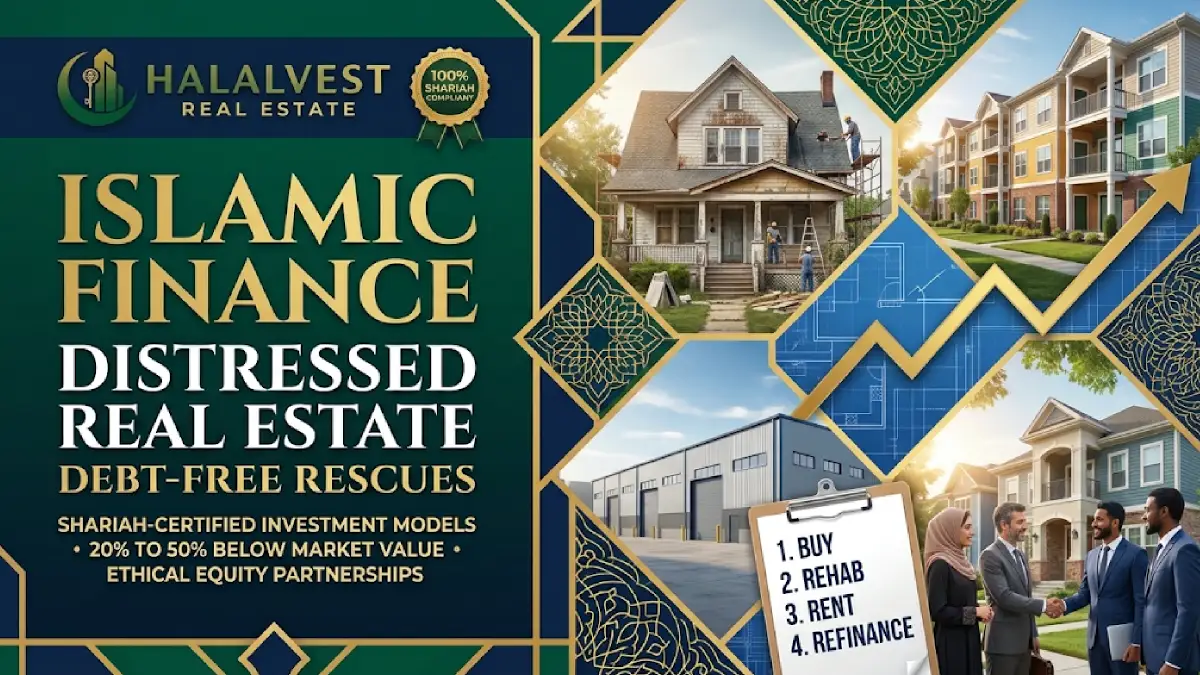
Many American families and business owners face mounting financial pressure today. High interest rates make traditional mortgages hard to pay. Property defaults are rising fast across the country. You do not have to rely on interest-based debt to build real wealth.
If you want to protect your capital and your faith, exploring distressed real estate Islamic finance gives you a proven path forward. You can buy deeply discounted assets without taking on interest.
Halalvest Real Estate LLC helps Muslim investors find these hidden opportunities. Our team finds properties selling at 20% to 50% below market value. We acquire pre-foreclosures, tax sales, and bank auctions. Then, we transform them using 12 Shariah-certified investment models.
What Is the Real State of Distressed Real Estate Islamic Finance Today?
The US housing market shows clear signs of financial stress. Foreclosure filings reached nearly 228,000 in the first half of the year. That is a 21% jump from last year and a 28% rise over two years.
Some states face severe property pressure. Idaho saw foreclosure filings jump by 59%. Colorado filings climbed 57%. Georgia filings rose 52%. In Florida, one in every 2,106 homes received a foreclosure notice in a single month.
Home price growth has slowed down to 1.4% per year. Short sales rose 16% as sellers tried to avoid foreclosures. Federal Reserve reports show rising default rates on commercial property loans. Banks want to clear non-performing debt from their books quickly.
This market stress creates massive buying opportunities. You can buy quality assets at deep discounts.
| Market Statistic | Recent Value | Market Impact |
| U.S. Foreclosure Filings | 228,000 filings | Surging auction inventory. |
| Foreclosure Growth | Up 21% year over year | Higher pre-foreclosure deal volume. |
| Short Sale Increase | Up 16% year over year | More discounted seller negotiations. |
| Annual Price Appreciation | 1.4% growth rate | Flat prices allow accurate budgeting. |
| Idaho Foreclosure Surge | Up 59% filing increase | Prime target area for acquisitions. |
| Florida Foreclosure Rate | 1 in 2,106 homes | Highest property distress rate. |
Why Do Ethical Investing Distressed Assets Islamic Principles Outperform Debt?
Conventional lenders treat distressed real estate like a debt trap. They charge high interest rates, late fees, and financial penalties. They push struggling property owners into bankruptcy.
Islamic finance works differently. It builds on real tangible assets, risk-sharing, and true trade. When you practice ethical investing distressed assets Islamic principles, you buy real assets through fair partnerships.
The Holy Quran gives clear guidance on trade:
“Allah has permitted trading and forbidden usury.” (Surah Al-Baqarah, 2:275)
Every deal must rest on full consent from both sides. We do not exploit homeowners in trouble. Surah An-Nisa states:
“Do not devour one another’s property wrongfully, unless it be by trade based on mutual consent.” (Surah An-Nisa, 4:29)
Honesty is mandatory when buying opportunities Sharia-compliant turnaround properties. Sellers and buyers must reveal all property defects up front. Prophet Muhammad (peace be upon him) said:
“The buyer and the seller have the option of cancelling or confirming the bargain unless they separate; and if both parties spoke the truth and described the defects and qualities of the goods, then they would be blessed in their transaction.” (Sahih Bukhari, Vol 3, Book 34, Hadith 321)
Islam commands leniency toward people facing debt problems. Prophet Muhammad (peace be upon him) said:
“May Allah’s mercy be on him who is lenient in his buying, selling, and in demanding back his money.” (Sahih Bukhari, Vol 3, Book 34, Hadith 2076)
Another Hadith reminds us of the divine reward for debt relief:
“Once a man died and was asked what he used to do in his lifetime. He replied: ‘I was a businessman and used to give time to the rich to repay his debt and deduct part of the debt of the poor.’ So he was forgiven.” (Sahih Bukhari, Vol 3, Book 34, Hadith 583)
Written contracts protect everyone involved in a deal. Surah Al-Baqarah commands:
“O Believers! Whenever you lend money for a particular period, write it down, and someone among you must write it justly.” (Surah Al-Baqarah, 2:282)
A reliable legal framework Islamic distressed real estate demands active oversight. Old certifications without fresh annual audits cannot guarantee compliance. Halalvest subjects all deals to annual Shariah audits. We verify every lease, renovation contract, and profit payout.
What Is the Difference Between Islamic vs Conventional Distressed Property Investment?
Understanding Islamic vs conventional distressed property investment helps you see the equity advantage.
Conventional investors use high-interest hard money loans. They pay 12% to 18% interest rates. If construction delays happen, interest compounds fast. The investor risks losing the asset to bank foreclosure.
Sharia-compliant solutions distressed property investment replace debt with direct equity co-ownership. Investors buy actual shares of the real estate. You share profits when the asset prospers. You share risks if project costs rise. No compound interest accumulates.
| Deal Metric | Conventional Distressed Deal | Islamic Distressed Deal |
| Funding Structure | Interest-bearing debt loans. | Asset-backed equity partnership. |
| Risk Allocation | Borrower takes all loss risk. | Risk is split by ownership shares. |
| Late Payment Terms | Late fees and default interest. | Debt workout without interest. |
| Asset Valuation | Predatory discount buying. | Mutual consent fair pricing. |
| Legal Documentation | Mortgages and promissory notes. | Partnership and sale contracts. |
| Community Goal | Maximize short-term debt yield. | Protect capital and rebuild property. |
How Islamic Finance Invests in Distressed Real Estate: 5 Core Strategies
Here is how Islamic finance invests in distressed real estate using Halalvest’s 12 proven investment models.
Strategy 1: Short-Term Asset Turnarounds via Hybrid Partnerships
Fixing distressed houses requires quick capital deployment and expert construction skills. Using Mudarabah in distressed real estate deals solves this balance.
In a Mudarabah contract, investors supply the cash as Rabb-ul-Mal. The managing partner supplies construction management as Mudarib.
- Model 1: Hybrid Musharakah + Mudarabah (Residential Fix & Flip): We buy single-family homes at 20% to 50% discounts. Investors fund purchase and repair costs. We sell the updated house and split profits based on pre-agreed ratios.
- Model 2: Hybrid Musharakah + Mudarabah (Multi-Family Renovation & Lease): We buy distressed apartment buildings with low tenant occupancy. Equity funds pay for structural repairs. We lease out units, stabilize cash flow, and collect rental returns.
Strategy 2: Debt-Free Rescues via Purchase and Build Contracts
Stalled building projects and commercial defaults need clear funding models. We deploy Islamic financing models rescuing distressed assets without using interest.
We use Murabaha (cost-plus sales) and Istisna (custom construction contracts). These contracts set clear prices up front.
- Model 3: Musharakah (Warehouse Acquisition): Investors partner to buy discounted storage facilities outright. Equity ownership provides direct rental income.
- Model 4: Hybrid Murabaha + Mudarabah (Retail Building Purchase): We buy distressed retail centers via Murabaha contracts. We manage property operations under a Mudarabah arrangement.
- Model 5: Murabaha (Warehouse Acquisition): Halalvest buys a distressed facility with clear title. We resell it to an operator at cost plus a fixed markup paid over time.
- Model 9: Hybrid Istisna + Murabaha (Suburban Duplex Build): We finish halted housing projects using Istisna construction agreements. Buyers purchase completed homes through Murabaha sales. This represents best practices Sharia-compliant distressed asset acquisition.
- Model 10: Hybrid Istisna + Musharakah (Condominium Development): We complete unfinished condo towers via Istisna contracts and sell units under shared equity.
Strategy 3: Income Protection via Lease-to-Own Financing
Distressed medical spaces and apartment buildings require steady cash flow. We turn these into halal investment opportunities in distressed real estate using Ijara contracts.
Ijara Muntahia Bi Tamleek is a lease that ends in full ownership transfer. The investment entity holds the property title. The tenant pays rental payments that gradually buy out the equity.
- Model 6: Ijara – Option to Buy (Medical Office Space): We buy distressed medical offices and lease them back to doctors. A simple promise (Wa’ad) lets doctors purchase the building later.
- Model 7: Ijara Muntahia Bi Tamleek (Apartment Building Acquisition): We acquire discounted apartment blocks. Rents connect to real market values instead of bank debt rates. Tenants gradually buy full title over time.
- Model 8: Ijara Muntahia bi Tamleek (Medical Diagnostic Equipment Lease): We finance medical real estate and expensive scan machines together. This restores clinic operations without interest loans.
Strategy 4: Portfolio Growth with Islamic REIT Funds
Large investors want diversified real estate holdings. Islamic private equity funds distressed real estate tap into institutional REIT models.
- Model 11: REIT + Musharakah (Mixed-Use Multifamily REIT): Pooled capital buys apartment and retail assets. Local Musharakah joint ventures handle day-to-day upgrades. Investors earn regular dividend checks.
- Model 12: REIT + Musharakah (Retail REIT): Our master REIT buys distressed shopping centers at 20% to 50% discounts. We recruit ethical commercial tenants to increase monthly rental returns.
Strategy 5: Navigating Market Hurdles, SPVs, and Ownership Transfers
When navigating distressed real estate market Islamic financing, you must solve legal hurdles.
Property foreclosures often involve tax liens, unpaid contractor claims, and bank defaults. You must address challenges Islamic finance distressed property investment brings through disciplined legal structuring.
First, place every asset inside an independent Special Purpose Vehicle (SPV). An SPV isolates legal risks from the rest of your portfolio.
Second, clear all existing interest-bearing debt at closing. You cannot assume a conventional bank mortgage. All old debts must be paid off or legally canceled.
Third, avoid double transfer taxes. Structuring property transfers through direct SPV membership assignments prevents duplicate real estate transfer taxes.
Fourth, mandate ongoing Shariah audits. Independent scholars must check books annually to keep every income stream 100% halal.
How Do Case Studies in Islamic Distressed Real Estate Prove Success?
These real-world case studies Islamic distressed real estate demonstrate how ethical structures deliver high financial returns.
Case Study 1: Atlanta Multi-Family Foreclosure Workout
A 48-unit apartment complex in Atlanta fell into default when the owner could not pay a $5.2 million bank loan. The property needed major repairs. Occupancy dropped to 38%.
Halalvest bought the property at auction for $3.2 million cash. That was a 44.8% discount from its peak value.
We used Model 2 (Hybrid Musharakah + Mudarabah). Investors contributed $3.2 million purchase funds and $1.1 million renovation funds. Halalvest managed construction and tenant leasing.
Within 18 months, tenant occupancy reached 94%. Net operating income rose 118%. The stabilized property sold for $7.1 million. Investors earned a 22.4% annualized return without interest.
Case Study 2: Columbus Commercial Warehouse Rescue
A 120,000-square-foot warehouse in Columbus faced foreclosure due to rising interest rates on a bank credit line. The building was in great shape, but debt costs broke the owner’s cash flow.
Halalvest bought the facility for $4.5 million cash, clearing all bank liens. We deployed Model 5 (Murabaha) and Model 7 (Ijara Muntahia Bi Tamleek).
We leased the warehouse to a regional logistics firm. Monthly lease payments gave investors a 9.8% annual cash yield. The lease schedule amortized the purchase price over 7 years, transferring full title to the tenant upon completion.
Full Breakdown of Halalvest’s 12 Investment Models
| Model Number | Model Name | Target Real Estate Asset | Shariah Mechanics | Investment Term |
| Model 1 | Hybrid Musharakah + Mudarabah | Single-Family Fix & Flip | Equity co-ownership + manager partnership. | 6 to 18 months |
| Model 2 | Hybrid Musharakah + Mudarabah | Multi-Family Apartments | Shared equity + property management. | 2 to 4 years |
| Model 3 | Musharakah | Industrial Warehouses | Direct equity partnership. | 3 to 7 years |
| Model 4 | Hybrid Murabaha + Mudarabah | Retail Shopping Centers | Cost-plus sale + operational management. | 2 to 5 years |
| Model 5 | Murabaha | Logistics Facilities | Fixed cost-plus installment sale. | 1 to 3 years |
| Model 6 | Ijara – Option to Buy | Medical Office Spaces | Operating lease + purchase option. | 3 to 5 years |
| Model 7 | Ijara Muntahia Bi Tamleek | Multi-Family Housing | Lease ending in title transfer. | 5 to 10 years |
| Model 8 | Ijara Muntahia Bi Tamleek | Medical Diagnostic Tools | Asset-backed equipment lease. | 3 to 5 years |
| Model 9 | Hybrid Istisna + Murabaha | Suburban Duplex Builds | Construction contract + cost-plus resale. | 18 to 36 months |
| Model 10 | Hybrid Istisna + Musharakah | Urban Condo Development | Building contract + shared unit sales. | 2 to 4 years |
| Model 11 | REIT + Musharakah | Mixed-Use Multi-Family | Pooled REIT trust + joint ventures. | 5+ years |
| Model 12 | REIT + Musharakah | Retail Shopping Hubs | Institutional REIT buying discounted centers. | 5+ years |
The U.S. property market offers rare opportunities to buy quality assets at deeply discounted prices. Rising foreclosures and bank debt defaults create buying chances across the nation.
Choosing distressed real estate Islamic finance allows you to grow your wealth while honoring your religious values. You avoid harmful interest debt, protect asset value, and support fair trade in local communities.
Halalvest Real Estate LLC stands ready to help you invest with confidence. Our network of over 1000 real estate brokers, loan officers, and private investors finds high-yielding deals every day. Contact Halalvest today to access our 12 Shariah-certified real estate investment models!
FAQs
Can non-Muslims invest in Islamic property funds?
Yes, non-Muslim investors can freely join ethical real estate funds. These deals attract anyone seeking fair equity partnerships. Every participant receives identical profit splits, full ownership rights, and shared risk protections regardless of their personal religious background.
Do Islamic deals require higher down payments?
No, Islamic financing models do not inherently require higher down payments than conventional loans. Asset acquisition costs depend on total property valuations and equity splits. Direct investor pooling allows capital providers to fund projects flexibly without rigid cash rules.
Can foreign investors buy American distressed real estate?
Yes, international investors can acquire American distressed properties using Shariah-compliant fund structures. Special Purpose Vehicles allow global partners to invest safely. These entities manage local tax filings, property titles, and rental distributions while ensuring complete ethical compliance.
Do Shariah real estate investments pay regular dividends?
Yes, income-generating models like Ijara leases and REIT partnerships deliver ongoing cash distributions. Tenants pay monthly rents directly into the partnership bank accounts. Investors receive regular payouts after operational fees are settled, creating predictable passive income streams.
Can investors convert conventional debt properties into halal?
Yes, property owners can refinance interest debt by replacing mortgages with asset-backed Islamic contracts. The process settles existing bank debt completely at closing. Investors then transition the asset into a clear Musharakah partnership or Ijara lease structure.
About the Editor
Mufti Qari Muhammad Jehangir TareenMufti Qari Muhammad Jehangir Tareen is a respected Islamic scholar specializing in Shariah compliance, Islamic finance, and the application of classical jurisprudence to modern investment structures. He has extensive experience reviewing real estate investment models and educational content to ensure alignment with Islamic principles. His work emphasizes the avoidance of riba, excessive gharar, and maysir, while promoting asset-backed, transparent, and ethical risk-sharing frameworks. Mufti Jehangir is well-versed in Shariah-compliant structures such as Musharakah, Mudarabah, Murabaha, Ijara, and Istisna. His reviews focus on proper contractual execution and clear communication to avoid any implication of guaranteed returns. And Allah knows best.