
 Google AI
 ChatGPT
 Perplexity
You want to grow your family’s money in American real estate. You also want to protect your faith. Finding deals that satisfy both goals feels tough in today’s housing market.
Most home buyers search on public websites. They look at open property portals. They bid on houses that everyone else can see.
Public home sites trigger fast bidding wars. They push sale prices higher every day. Most buyers use bank loans with high interest rates to win those homes.
Interest debt breaks your spiritual goals as a Muslim investor. You need clean options that match your values. You need investments that protect your capital and your religion.
Private real estate purchases offer a better path. Finding unlisted houses gives you a real edge over public buyers. This guide explains off-market real estate halal investment so you can build wealth with peace of mind.
Off-market home deals happen directly between buyers and sellers. No public agent listings push prices up. No aggressive bidding wars happen on open portals.
Halalvest Real Estate LLC helps Muslim families navigate this space. Our platform connects over 1,000 licensed real estate brokers, loan officers, and private investors across the country.
We find unlisted homes priced 20% to 50% below full market value. We locate pre-foreclosures, estate sales, and distressed houses before public buyers see them.
We create pathways for off-market real estate for Muslim investors who want clear choices. You can grow your financial savings and keep your faith intact.
Building real estate wealth requires ethical off-market property investment for Muslims. Let us review how Sharia principles guide these private transactions.
Understanding Sharia Principles in Off-Market Real Estate
Is Off-Market Real Estate Halal in Islam?
Buying unlisted property directly from its lawful owner may be permissible when the ownership, sale terms, property rights, and transaction structure comply with Shariah principles. Islamic law allows direct real estate sales when both parties agree on fair terms.
You must follow clear rules to keep transactions pure. You need full honesty, direct agreement, and zero interest charges.
The Holy Quran establishes the core foundation for honest business trade:
“O you who have believed, do not consume one another’s wealth unjustly but only in business [conducted by] mutual consent.” (Surah An-Nisa, 4:29)
Direct deals meet this Quranic standard through true mutual agreement (An-Taradin). The seller chooses to sell without public pressure. The buyer offers cash or joint equity without hidden traps.
Prophet Muhammad (peace be upon him) taught complete honesty in trading. His teachings appear in Sahih al-Bukhari, where he warns against hiding property defects.
Buying a distressed house at a discount is totally ethical when you share all repair details. The lower price reflects needed physical fixes, not deceptive bargaining.
Key Pillars: Riba, Gharar, and Mutual Agreement
- Eliminating Riba (Interest): Conventional mortgages use interest debt. Islam strictly forbids interest. Halal property purchases replace interest loans with shared property equity or trade profit margins.
- Removing Gharar (Uncertainty): Off-market contracts must avoid hidden risks. You need independent property inspections, title checks, and written contract terms.
- Practicing An-Taradin (Mutual Consent): Both buyer and seller must enter the contract freely. Sellers facing financial hardship receive fast cash solutions without predatory tricks.
Focusing on avoiding riba in off-market real estate transactions keeps your earnings clean. Direct property acquisitions help you build real equity through pure trade.
Why Choose Off-Market Over Public Listings?
Public real estate listings force buyers to pay top dollar. Competition drives prices far past actual property values.
Unlisted property deals remove public competition. You deal directly with property owners who want simple sales.
Data from ATTOM Data shows that off-market foreclosure sales sell at an average discount of 33% below fair market value. Buying at a one-third discount gives you an instant equity cushion.
ATTOM reports show that typical home sale profit margins fell to 44.1%. Public sellers struggle to maintain peak profits. Buying off-market lets you secure strong returns even when wider housing markets slow down.
Public auctions and listing sites often favor buyers with high-interest hard money loans. Private off-market deals let you deploy patient equity capital. You skip bank interest completely.
| Market Feature | Public MLS Listings | Halal Off-Market Sourcing |
| Purchase Price | Retail price or bidding war premium. | 20% to 50% discount below market value. |
| Buyer Competition | Dozens of public bids. | Exclusive direct talks with the seller. |
| Financing Type | Conventional interest mortgages. | Shariah-certified partnerships and trade sales. |
| Closing Speed | 45 to 60 days with bank delays. | Fast closing based on seller needs. |
| Equity Buffer | Minimal equity at purchase closing. | Strong immediate equity upon purchase. |
Applying best practices for halal off-market real estate investing gives you better pricing and clean contract structures. You avoid public bidding stress while securing solid property deals.
How Do You Spot Hidden Property Opportunities Before Others?
Locating unlisted properties requires proactive outreach. You cannot wait for properties to pop up on public sites.
Learning how to find halal off-market real estate deals opens up reliable channels. You can build direct property pipelines in your local area.
Work With Professional Networks
Partner with local real estate brokers, wholesalers, and property managers. Agents often know about pocket listings before homes hit public databases.
Halalvest Real Estate LLC shares private leads across a national network. Our 1,000 brokers and loan officers bring fresh unlisted options to our platform every week.
Target Distressed and Pre-Foreclosure Homes
Distressed property owners often need fast resolution. Direct contact gives them a clean exit before public bank foreclosures happen.
- Pre-Foreclosure Filings: ATTOM reports 227,548 total foreclosure filings in the first half of 2026 alone. Foreclosure starts rose 18% to 164,566 properties. Connecting with these owners helps them save their credit and extract remaining home equity.
- Inherited Properties: Heirs who inherit distant real estate often want quick cash sales. They prefer direct cash offers over paying real estate agent commissions.
- Vacant Houses: ATTOM reports a national residential vacancy rate of 1.3%. Unoccupied “zombie” foreclosures rose to 3.4%. Finding empty homes helps you spot neglect before repairs get too costly.
Use Direct Sourcing Methods
Try halal ways to buy unlisted property by contacting owners directly. Send targeted letters to out-of-state landlords. Search county tax records for unpaid property taxes.
Using direct channels helps you succeed in finding Sharia-compliant private real estate investments. You build personal trust with sellers while finding great property values.
Sharia-Compliant Off-Market Property Investment Strategies
The global Islamic finance industry holds over $5.98 trillion in total assets. Financial experts project total assets will hit $8.46 trillion by 2031. Standard Chartered estimates global Islamic banking assets will reach $7.5 trillion by 2028.
Demand grows rapidly across the United States. North America hosts over 3.5 million Muslim consumers. More than 45% of domestic Islamic financial products focus directly on real estate acquisitions.
You must structure private deals with clean financial tools. Deploying Sharia-compliant off-market property investment strategies eliminates interest and shares real property risk fairly.
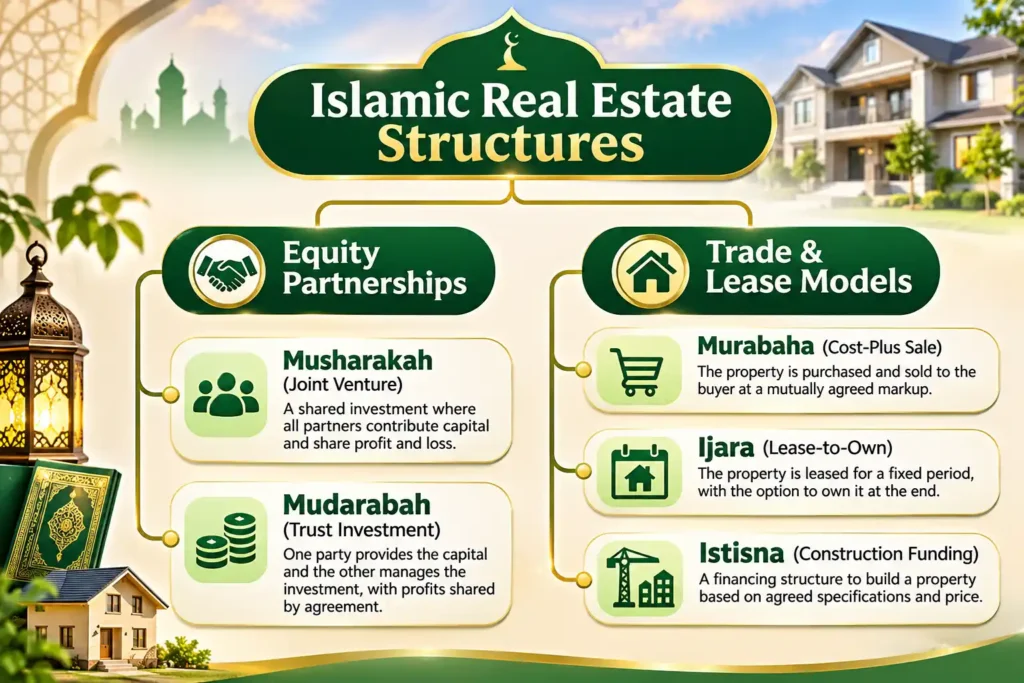
Equity Partnerships: Musharakah and Mudarabah
- Musharakah (Joint Ownership): You put up capital alongside equity partners to buy a property. You share net rental income based on agreed ownership percentages. You split physical asset losses strictly by equity contributions.
- Mudarabah (Trustee Management): One investor provides purchase funds. An expert manager handles property acquisition, repairs, and tenant leasing. In a properly structured Mudarabah, profits are shared according to a pre-agreed percentage, while financial losses are borne by the capital provider unless caused by the manager’s misconduct or negligence.
Trade and Lease Contracts: Murabaha, Ijara, and Istisna
- Murabaha (Cost-Plus Sale): A capital platform purchases the unlisted property directly. The platform sells the property to you at cost plus a transparent profit fee. You pay the fixed balance over time without interest.
- Ijara Muntahia Bi Tamleek (Lease-to-Own): The investor group purchases the asset and leases it to an occupant. Under a properly structured Ijarah Muntahia Bi Tamleek, the lessee pays rent for the use of the asset, while ownership may be transferred through a separate Shariah-compliant mechanism according to the agreed terms.
- Istisna (Construction Financing): Capital disburses in planned stages to fund ground-up duplex or condo builds. Contracts convert into cost-plus or leasing agreements once construction finishes.
Understanding structuring halal off-market real estate partnerships helps you build sustainable wealth. You use Islamic financing for off-market property acquisition to keep every dollar completely clean.
Where to Find Halal Off-Market Commercial Real Estate?
Finding commercial real estate offline requires proven industry connections. Off-market commercial properties rarely list publicly. Owners prefer quiet private transactions.
Halalvest Real Estate LLC offers 12 Shariah-certified investment models. We provide a complete guide to Islamic off-market residential property investment alongside commercial property opportunities.
Residential Real Estate Models
- Hybrid Musharakah + Mudarabah (Residential Fix & Flip): We buy distressed single-family homes at 20% to 50% discounts. We fund physical updates and split final resale profits cleanly.
- Hybrid Musharakah + Mudarabah (Multi-Family Renovation & Lease): We acquire underperforming apartment buildings off-market. We renovate units, stabilize tenant occupancy, and distribute rental cash flow.
- Hybrid Istisna + Murabaha (Suburban Duplex Build): We fund ground-up residential duplex construction using progress payments. We transfer finished homes using fixed deferred sales.
- Hybrid Istisna + Musharakah (Condominium Development): We fund multi-family urban condo projects from land acquisition through final unit sales.
Commercial and Industrial Real Estate Models
- Musharakah (Warehouse Acquisition): We partner with investors to buy unlisted logistics hubs leased to corporate tenants.
- Hybrid Murabaha + Mudarabah (Retail Building Purchase): We purchase retail centers using cost-plus contracts paired with professional property management.
- Murabaha (Warehouse Acquisition): We provide fixed-margin cost-plus acquisition funding for industrial business owners buying storage units.
- Ijara – Option to Buy (Medical Office Space): We acquire medical office buildings and lease them to healthcare providers with pre-negotiated equity options.
- Ijara Muntahia Bi Tamleek (Apartment Building Acquisition): We structure multi-family residential purchases through progressive leases that transfer title upon term end.
- Ijara Muntahia Bi Tamleek (Medical Equipment Lease): We finance healthcare diagnostic machinery inside our clinical properties using lease-to-own terms.
Institutional Fund Models
- REIT + Musharakah (Mixed-Use Multifamily REIT): We pool investor funds into Shariah-compliant mixed-use funds yielding regular dividends.
- REIT + Musharakah (Retail REIT): We buy unlisted commercial retail corridors leased to creditworthy business tenants.
| Model Name | Core Shariah Model | Targeted Real Estate Sector |
| Fix & Flip Partnership | Hybrid Musharakah + Mudarabah | Single-Family Houses |
| Multi-Family Value-Add | Hybrid Musharakah + Mudarabah | Apartment Complexes |
| Industrial Warehouse JV | Pure Musharakah | Logistics Hubs |
| Commercial Retail Purchase | Hybrid Murabaha + Mudarabah | Shopping Centers |
| Industrial Murabaha | Direct Cost-Plus Sale | Warehouses & Storage |
| Medical Office Lease | Ijara with Purchase Option | Healthcare Properties |
| Multi-Family Lease-to-Own | Ijara Muntahia Bi Tamleek | Residential Units |
| Medical Equipment Lease | Ijara Muntahia Bi Tamleek | Clinical Machinery |
| Duplex Build Financing | Hybrid Istisna + Murabaha | Residential Construction |
| Condo Development | Hybrid Istisna + Musharakah | Urban Infill Projects |
| Mixed-Use REIT | REIT + Musharakah | Mixed-Use Real Estate |
| Commercial Retail REIT | REIT + Musharakah | Commercial Shopping Hubs |
Knowing where to find halal off-market commercial real estate gives you access to high-yield assets. You can grow your wealth safely across diverse asset classes.
How Do You Balance Risks and Rewards in Private Deals?
Private real estate purchases offer lower prices and high returns. They also carry unique physical risks.
Unlisted houses bypass standard public disclosure rules. You must manage due diligence carefully to protect your capital.
Weighing the risks and rewards of halal off-market real estate requires strict operational guidelines.
Inspect Physical Property Conditions
Distressed properties sold below market value often need significant repairs. Foundation damage, old roofs, or leaking pipes can wreck your budget.
Hire licensed third-party property inspectors before signing final purchase contracts. Accurate repair budgets prevent unexpected cost overruns.
Run Comprehensive Title Searches
Off-market properties may carry hidden legal debts. Past tax delinquencies, unpaid contractor liens, or secondary mortgages cloud property titles.
Run complete title searches through licensed title companies. Verify that all outstanding liens clear before transfer of ownership.
Verify Shariah Compliance
Avoid hidden interest clauses or non-compliant debt terms. Relevant agreements should undergo appropriate independent Shariah review to ensure that their terms comply with Shariah.
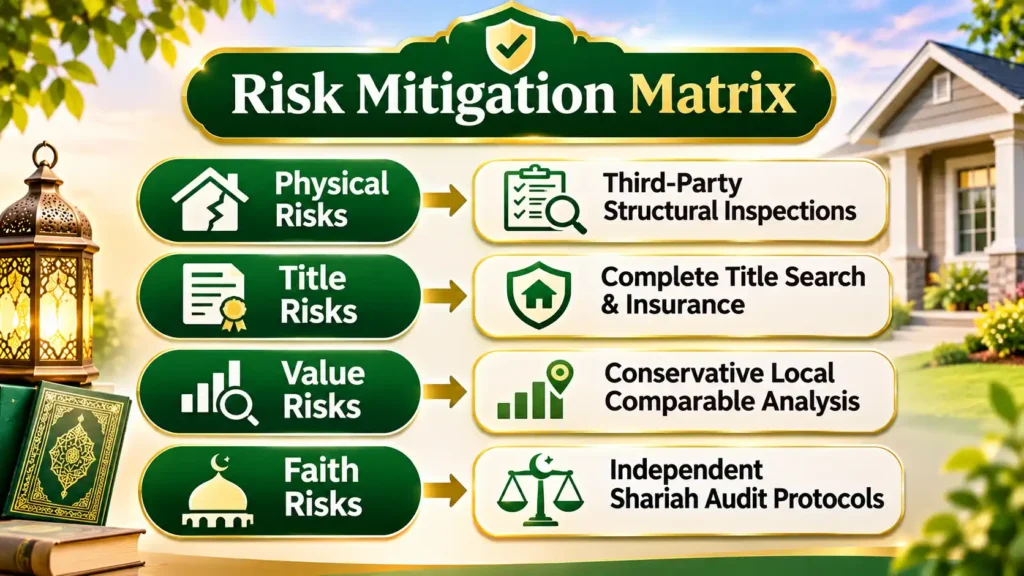
| Identified Risk | Real Estate Threat | Mitigation Protocol |
| Property Repairs | Hidden physical building damage. | Require third-party physical inspections before closing. |
| Clouded Title | Unpaid tax liens or extra mortgages. | Mandate full title searches and title insurance policies. |
| Value Estimates | Overestimating post-renovation values. | Base valuation on verified local property sales. |
| Non-Compliance | Accidental interest clauses in contracts. | Subject contracts to independent Shariah review. |
Following these guidelines protects your investment funds. You preserve capital while earning steady halal profits.
Off-Market Real Estate Halal Investment: Your Path to Faith-Based Wealth
Finding profitable real estate deals without breaking your religious values is completely achievable. Private off-market property sourcing lets you bypass public bidding wars, acquire assets at 20% to 50% discounts, and build true equity.
Deploying asset-backed structures keeps your money working hard. You avoid bank interest, share real asset risks fairly, and secure long-term family wealth.
Halalvest Real Estate LLC bridges the gap between strong financial returns and strict Islamic principles. Our national network of over 1,000 brokers, loan officers, and private investors unlocks high-grade unlisted properties across the United States.
Choosing Shariah-compliant off-market real estate investment may provide opportunities to grow your assets while maintaining your religious commitments, subject to investment risks. Connect with our team today to explore our Shariah-certified investment models and build faith-based real estate wealth.
FAQs
Can real estate wholesalers assign contracts halally?
Yes. Assignment of a real estate contract may be permissible when the underlying contract and the assigned rights permit such an assignment and the arrangement is transparent and Shariah-compliant.
Do halal real estate investments pay property taxes?
Yes. Islamic principles require full compliance with local municipal laws and legal government duties. Investors must pay all property taxes, utility fees, and civic assessments on time. Meeting these public obligations keeps your investment business completely lawful and clean.
Is earnest money permissible in Islamic property contracts?
Earnest money (Arboon) may be permissible under recognized Shariah conditions, including clearly defined terms and a specified period. If the buyer completes the purchase, the deposit counts toward the total price. If the buyer defaults without cause, the seller keeps the funds.
Can non-Muslims join halal real estate partnerships?
Yes. Non-Muslims can freely participate in Islamic real estate ventures as equity partners or tenants. The partnership agreement must simply follow ethical Shariah rules. All partners share profits and losses based on asset performance without interest debt terms.
Must property management companies follow Shariah standards?
Yes. Property managers handling halal real estate must enforce ethical tenant policies. They cannot lease units to businesses involved in gambling, alcohol, or interest operations. They must handle tenant security deposits and maintenance accounts without using interest bank options.

About the Editor
Mufti Qari Muhammad Jehangir TareenMufti Qari Muhammad Jehangir Tareen is a respected Islamic scholar specializing in Shariah compliance, Islamic finance, and the application of classical jurisprudence to modern investment structures. He has extensive experience reviewing real estate investment models and educational content to ensure alignment with Islamic principles. His work emphasizes the avoidance of riba, excessive gharar, and maysir, while promoting asset-backed, transparent, and ethical risk-sharing frameworks. Mufti Jehangir is well-versed in Shariah-compliant structures such as Musharakah, Mudarabah, Murabaha, Ijara, and Istisna. His reviews focus on proper contractual execution and clear communication to avoid any implication of guaranteed returns. And Allah knows best.